

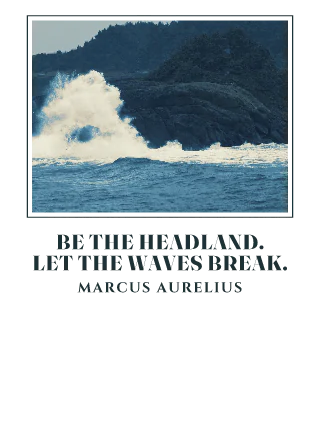
The Max, The Headland, Gold
From the library
Marcus Aurelius, Meditations: every book, section by section
Every section of the Meditations we carry, in book order from Book 1 to Book 12, translated from the Greek or in George Long's 1862 English, each with its meaning and its tee.
Marcus Aurelius ruled Rome from 161 to 180, and for most of the last decade of his life he was at war on the Danube frontier. In those years he kept a private notebook in Greek, the language of philosophy in his day. He never meant it for readers. The oldest title on the manuscripts is Ta eis heauton, which means simply "to himself". We call it the Meditations.
The notebook comes down to us in twelve books and about 488 short sections. Book 1 is a list of debts: what he learned from his grandfather, his mother, his teachers and the emperor who adopted him. Book 2 carries the heading "Among the Quadi, on the Gran", a river in what is now Slovakia, and Book 3 "At Carnuntum", the legion camp near modern Vienna. The rest are undated. Some sections are one line long; a few run for a page. Several in Books 7 and 11 are lines he copied from writers he loved, above all Epictetus, and those are credited to their authors here.
The best-known modern English versions of the Meditations are under copyright. We work from the Greek, and from the English of George Long, whose translation of 1862 is free to use, and we make each printed line our own: short enough for a shirt, faithful to what Marcus wrote. Every line links to its own page with the Greek, the passage it comes from, and a plain note on what it means and how to live it.
Below, the lines are set out in Marcus' own order, Book 1 to Book 12, section by section. Read straight through, they make a portrait of a man in the hardest job in the world, reminding himself each morning to be patient, to be useful, to fear nothing that happens and to waste no time.
Every line here can be printed on any of our tees, in any of our looks, made to order.
On a shirt now


The Max, The Flat Bay, Black

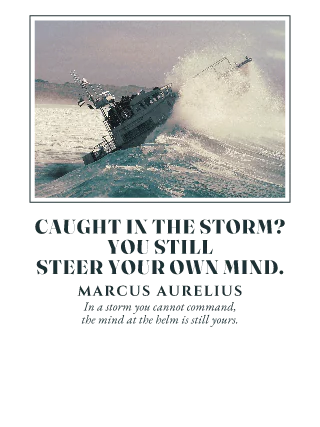
The Max, Crossing the Bar, Turquoise

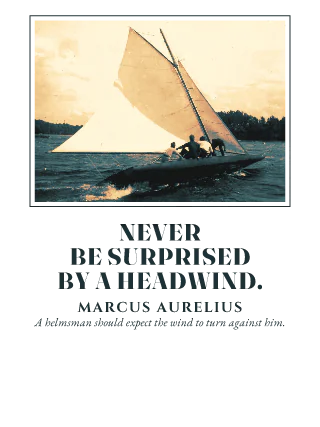
The Max, Beating to Windward, Orange

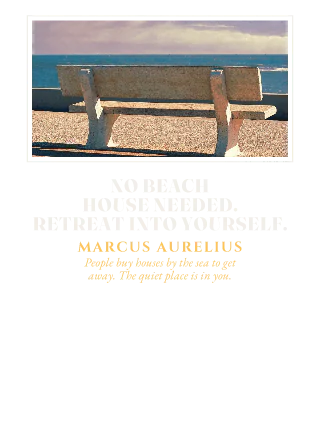
The Sun-Washed, The Empty Bench, Emerald

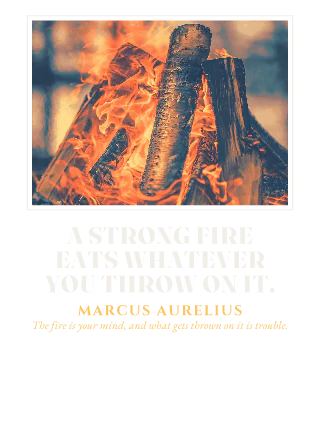
The Heavyweight, The Strong Fire, Black

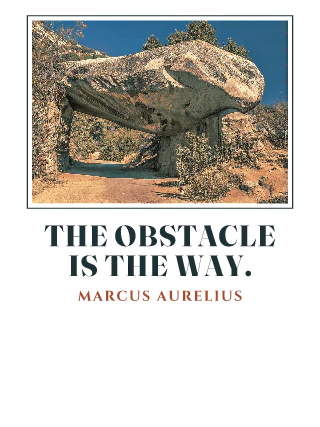
The Sun-Washed, Tunnel Rock, Lagoon Blue


The Sun-Washed, First Light, Burnt Orange
The twelve books
Private notes Marcus wrote to himself, in Greek, in the 170s, most of them on campaign. Lines he copied from Epictetus, Plato and others are credited to them.
Book 1
His debts: what he learned from family, teachers and friends. 30 lines
- Good-natured, and slow to anger.
Meditations 1.1
Book One of the Meditations is a list of debts: what Marcus took from each person who formed him. He begins with his grandfather, Annius Verus, and names two gifts: good character and freedom from anger.
The first line of the Meditations thanks a grandfather for a good disposition and a temper kept in check. The two travel together, because anger is usually the first thing that spoils a decent nature. Be easy to live with, and make people work hard to get a rise out of you.
- Modest and manly.
Meditations 1.2
In his list of debts Marcus thanks the reputation and memory of his father, Annius Verus, for modesty and manliness. He is thanking a father he knew through what was said and remembered of him.
Marcus credits the remembered example of his father with two qualities that seem to pull apart: modesty and a man's strength. Together they make a person who can act firmly without needing to be seen doing it. Do the hard thing, then say little about it.
- No evil deeds. Not even evil thoughts.
Meditations 1.3
Marcus thanks his mother, Domitia Calvilla, also called Lucilla, for piety and generosity, for keeping clear of wrong even in thought, and for a plain way of living far from the habits of the rich.
From his mother Marcus learned to hold back not only from doing wrong but from entertaining it in his mind. Most bad acts begin as a thought someone allowed to stay. Notice the first flicker of spite or temptation and refuse it a seat.
- Live simply, far from the habits of the rich.
Meditations 1.3
Marcus thanks his mother, Domitia Calvilla, also called Lucilla, for piety and generosity, for keeping clear of wrong even in thought, and for a plain way of living far from the habits of the rich.
The future emperor learned from his mother to live plainly, keeping his daily habits far from the style of the wealthy. Simplicity was a choice, not a lack. Whatever you earn, keep your needs small enough that money never owns you.
- On good teachers, spend freely.
Meditations 1.4
Marcus thanks his great-grandfather, perhaps Catilius Severus, for having him taught by good teachers at home rather than in the public schools, and for the lesson that on such things a man should spend generously.
Marcus was grateful that his family spent generously on teaching him well. Of all the places to be careful with money, learning is the last. Pay for the coach, the course, the book or the mentor who can make you better.
- Want little. Work with your hands.
Meditations 1.5
In his opening list of what he learned from others, Marcus credits his tutor with teaching him to endure labour, to want little and to work with his own hands. It is striking advice for a future emperor. Keep your needs modest and your hands busy. Fix the ding, cook the meal, build the shelf, and stay connected to real work.
- Waste no passion on trifles.
Meditations 1.6
Diognetus was probably an early tutor of Marcus. From him Marcus took a distrust of wonder-workers and quail fights, a love of philosophy, and, as a boy, a longing for the plank bed and hide of the Greek training.
Diognetus taught the young Marcus not to get worked up over things that do not matter, like the quail fights that were the craze of the day. Passion is limited, so spend it where it counts. Let the fads and squabbles pass and save your fire for real work.
- Learn to take the blunt truth.
Meditations 1.6
Diognetus was probably an early tutor of Marcus. From him Marcus took a distrust of wonder-workers and quail fights, a love of philosophy, and, as a boy, a longing for the plank bed and hide of the Greek training.
Among his first lessons Marcus lists learning to put up with frank speech, even when it was aimed at him. Anyone with power soon hears only what pleases him. Keep a few people who tell you the hard thing, and thank them when they do.
- Admit your character needs work.
Meditations 1.7
Quintus Junius Rusticus was a Stoic philosopher whose advice Marcus valued highly. He made Marcus see that his character needed work, taught him to read closely and to write plainly, and lent him his own copy of the discourses of Epictetus.
The first thing Rusticus gave Marcus was the realization that his character needed correcting and training. Growth starts with that admission. Look honestly at your habits and temper, and treat them as a project, not a fixed fact.
- Don't put your discipline on display.
Meditations 1.7
Quintus Junius Rusticus was a Stoic philosopher whose advice Marcus valued highly. He made Marcus see that his character needed work, taught him to read closely and to write plainly, and lent him his own copy of the discourses of Epictetus.
Rusticus warned Marcus against parading his self-discipline or his good deeds for an audience. Training done for show turns into a performance. Keep your early mornings, your fasting and your giving quiet, and let the results speak.
- Read closely. Don't settle for the gist.
Meditations 1.7
Quintus Junius Rusticus was a Stoic philosopher whose advice Marcus valued highly. He made Marcus see that his character needed work, taught him to read closely and to write plainly, and lent him his own copy of the discourses of Epictetus.
Rusticus taught Marcus to read with care and not to be content with a rough idea of a book, nor to agree quickly with smooth talkers. Skimming feels like learning but rarely changes anyone. Read fewer things, slowly, and wrestle with them until they are yours.
- When they want peace, make peace fast.
Meditations 1.7
Quintus Junius Rusticus was a Stoic philosopher whose advice Marcus valued highly. He made Marcus see that his character needed work, taught him to read closely and to write plainly, and lent him his own copy of the discourses of Epictetus.
From Rusticus Marcus learned to be easily reconciled with people who had offended him, the moment they showed they wanted to come back. Holding out for a grovelling apology only prolongs the damage. When someone reaches toward you, meet them quickly.
- Same person in pain, in loss, in the long haul.
Meditations 1.8
From Apollonius, Marcus learned to be always the same: in sharp pain, at the loss of a child, through long illness. Steadiness that only holds in good weather is not steadiness. Aim for a character that does not swing with circumstance. The person who shows up on the worst day the same way as the best is the one people can lean on.
- Dignity without pretense.
Meditations 1.9
Sextus of Chaeronea, a philosopher related to Plutarch, was one of his teachers. Marcus remembers his kindness, his patience with the ignorant, his dignity without airs, and his great learning worn lightly.
Marcus admired in Sextus a seriousness that was entirely unforced. Real dignity does not need a pose, a title or a tone of voice. Be steady and decent, and the respect will come without your asking for it.
- Free of passion. Full of affection.
Meditations 1.9
Sextus of Chaeronea, a philosopher related to Plutarch, was one of his teachers. Marcus remembers his kindness, his patience with the ignorant, his dignity without airs, and his great learning worn lightly.
Sextus never showed anger or any other passion, Marcus writes, yet he was also deeply affectionate. Calm and warmth are not opposites. You can be impossible to rattle and still be the most loving person in the room.
- Know a lot. Show little of it.
Meditations 1.9
Sextus of Chaeronea, a philosopher related to Plutarch, was one of his teachers. Marcus remembers his kindness, his patience with the ignorant, his dignity without airs, and his great learning worn lightly.
Sextus had great learning and never showed it off. Knowledge worn lightly is useful to others; knowledge brandished just makes them feel small. Learn as much as you can, then use it to help, not to impress.
- Don't scold a mistake. Just say it right.
Meditations 1.10
Alexander of Phrygia was a teacher of grammar and a commentator on Homer. When someone used a wrong or clumsy word, he never scolded; he simply used the right word himself in his reply.
Alexander the grammarian never shamed people for a slip of speech. He worked the right word into his answer and moved on to the matter itself. Correct people by example rather than by pointing, and they will learn without losing face.
- Know the tyrant's tools: envy, cunning, the mask.
Meditations 1.11
Marcus Cornelius Fronto was a rhetorician who stood high in Marcus's favor; letters between the two survive. Marcus credits him with teaching him to see the envy, cunning and hypocrisy that surround absolute power.
Fronto taught the young heir to recognize what envy, duplicity and hypocrisy look like in a tyrant. Knowing the marks of a vice is the first defence against catching it. Whenever you gain power over others, check yourself for those three.
- Busy is no excuse to neglect your people.
Meditations 1.12
From Alexander the Platonist, Marcus learned not to keep saying or writing that he had no time, or to use pressing business as an excuse to neglect the people around him.
Marcus learned not to keep excusing himself from what he owed his family and friends by pointing to urgent work. There will always be urgent work. The people you live with should not get only what is left over.
- A friend complains, even unfairly? Win him back.
Meditations 1.13
Cinna Catulus was a Stoic philosopher. From him Marcus learned to take a friend's complaints seriously even when they were unfair, to speak warmly of his teachers, and to love his children truly.
Catulus taught Marcus not to shrug off a friend's complaint, even an unreasonable one, but to work to bring the friend back to his usual warmth. Being right matters less than keeping the friendship. Listen, repair, and let the score go.
- Praise your teachers. Truly love your children.
Meditations 1.13
Cinna Catulus was a Stoic philosopher. From him Marcus learned to take a friend's complaints seriously even when they were unfair, to speak warmly of his teachers, and to love his children truly.
Two debts sit side by side in this lesson from Catulus: speak well of the people who taught you, and love your children for real. One looks back in gratitude, the other forward in care. Both are how good things pass from one generation to the next.
- Love your people. Love the truth. Love justice.
Meditations 1.14
Marcus calls this Severus his brother, though he had none; he was probably Claudius Severus, a philosopher. Through him Marcus came to know the lives of Cato and Brutus, and learned to love his kin, truth and justice.
The Greek is three compound words: lover of kin, lover of truth, lover of justice. Marcus learned all three from Severus. Put your people, honesty and fairness at the center, and most choices answer themselves.
- Hope well. Trust that your friends love you.
Meditations 1.14
Marcus calls this Severus his brother, though he had none; he was probably Claudius Severus, a philosopher. Through him Marcus came to know the lives of Cato and Brutus, and learned to love his kin, truth and justice.
Severus taught Marcus a hopeful temper and the habit of believing that his friends really loved him. Suspicion poisons friendship faster than any quarrel. Assume the best of the people who have stood by you, and be someone who deserves the same.
- Never make your friends guess what you want.
Meditations 1.14
Marcus calls this Severus his brother, though he had none; he was probably Claudius Severus, a philosopher. Through him Marcus came to know the lives of Cato and Brutus, and learned to love his kin, truth and justice.
With Severus, Marcus noticed, no one ever had to guess what he wanted or did not want. Plain speech is a kindness. Say what you mean, ask for what you need, and spare the people around you the work of reading your mind.
- Cheerful always. Never rushed. Never putting it off.
Meditations 1.15
Marcus admired a teacher, Maximus, for cheerfulness in all circumstances, for never being in a hurry and never putting things off. The two failures he avoided are opposites: rushing and procrastinating. The middle path is steady attention. Start on time, work at a sane pace, and keep your mood out of the weather.
- Know when to charge and when to ease off.
Meditations 1.16
Among the qualities Marcus saw in his adoptive father Antoninus was knowing from experience when to push hard and when to let up. Constant intensity burns people out; constant ease lets things slide. Training, parenting and business all need that judgment. Learn your rhythms and the job's rhythms, and know which moment calls for the sprint and which for recovery.
- You can live in a palace and still live plainly.
Meditations 1.17
Book One ends with thanks to the gods for nearly everything good in his life: family, teachers, friends, and the chance to live plainly in a palace. A note at its end places it among the Quadi at the Granua, on campaign near the Danube.
Marcus thanks the gods for a ruler and father who taught him that one can live at court without needing guards, fine robes, torches and statues. Surroundings do not decide how you live. Whatever you can afford, keep your habits close to those of an ordinary person.
- Honor those who raised you now, not someday.
Meditations 1.17
Book One ends with thanks to the gods for nearly everything good in his life: family, teachers, friends, and the chance to live plainly in a palace. A note at its end places it among the Quadi at the Granua, on campaign near the Danube.
Marcus was glad he hurried to honor the people who brought him up, instead of telling himself he would do it later because they were still young. Later has a way of not arriving. Thank, visit and repay the people who made you while they can enjoy it.
- Nothing stops me. Where I fall short, it's on me.
Meditations 1.17
Book One ends with thanks to the gods for nearly everything good in his life: family, teachers, friends, and the chance to live plainly in a palace. A note at its end places it among the Quadi at the Granua, on campaign near the Danube.
Counting his blessings, Marcus admits that nothing outside him stood in the way of living well; where he fell short, the fault was his own. That is a hard and freeing thought. Stop listing obstacles and own the gap between who you are and who you mean to be.
Book One ends with thanks to the gods for nearly everything good in his life: family, teachers, friends, and the chance to live plainly in a palace. A note at its end places it among the Quadi at the Granua, on campaign near the Danube.
Marcus's final entry in his list of debts begins with a simple inventory of the good people in his life. Gratitude is a practice of noticing. Every so often, name the people who made you, one by one.
Book 2
Headed "Among the Quadi, on the Gran": written on campaign by the Danube. 23 lines
Marcus begins his day expecting to meet the meddling, ungrateful, arrogant and deceitful. Because they act from ignorance of good and bad, and because no one can force his mind into wrong, he says none of them can truly harm him. Expect a few difficult people today. Their behaviour is theirs; your character is not up for grabs.
- Made to work together, like hands, like feet.
Meditations 2.1
In the same morning reflection, Marcus reasons that we are made for cooperation, like feet, hands, eyelids and the rows of upper and lower teeth. Working against one another is contrary to nature. The image works for any group effort. A crew, a family or a business functions like a body, and pulling against each other only hurts the whole.
- No longer a slave. No longer a puppet on strings.
Meditations 2.2
Marcus divides himself into a little flesh, a little breath and the ruling mind, and tells the mind it is time to stop being a slave jerked about by impulses. Every craving and grudge is a string someone or something can pull. Notice the tug and decide for yourself.
- Stop resenting the present. Stop dreading the future.
Meditations 2.2
The same note ends with two bad habits to drop: grumbling at what is and flinching at what may come. Both steal the only time you can act in. Accept today as your material and meet tomorrow when it gets here.
- Don't go out grumbling. Go out grateful.
Meditations 2.3
Marcus tells himself to settle his principles and drop his endless thirst for more books, so that he does not die complaining but cheerful and thankful from the heart. How you finish is shaped by how you live each day. Practise gratitude now so it is there at the end.
- What the whole brings is good for the part.
Meditations 2.3
For the Stoics, each life is a part of one great order, and what that order brings serves both the whole and its parts. It is a call to trust rather than resent. When something arrives that you did not choose, look for the way it fits a larger pattern.
- Your time has an edge. Clear the clouds now.
Meditations 2.4
Marcus reminds himself that a fixed limit of time has been set for him. If he does not use it to clear the clouds from his mind, he writes, it will go, and he will go, and it will never return.
Marcus reminds himself that his time has a fixed limit, and if he does not use it to clear the clouds from his mind, the chance will pass and not return. The urgency is about clarity, not productivity. Use your hours to sort out what you value and how you think. Confusion left alone does not lift on its own schedule.
- Do this like it's the last thing you'll ever do.
Meditations 2.5
Marcus says you can free yourself from distraction by doing each act of life as if it were the last, without carelessness, show or self-pity. Final things get full attention. Bring that care, not dread, to the ordinary: the email, the paddle out, the bedtime story. Work done as if it mattered completely tends to be your best work.
- One life each. Don't stake your happiness on other minds.
Meditations 2.6
Marcus scolds his own soul: each person has one life, and yours is nearly done, yet you do not respect yourself but place your well-being in other people's minds. Living for approval wastes the only life you have. Ground your sense of worth in your own conduct, not in what others think.
- Learn something new and good. Stop spinning.
Meditations 2.7
Do things from outside distract you, Marcus asks? Then give yourself time to learn something new and good and stop being whirled around. He also warns against the opposite error of busy people who toil with no aim. Replace frantic motion with purposeful learning: a skill, a language, a new break, a better way of working.
- No one's miserable for not reading other minds. Plenty are for not reading their own.
Meditations 2.8
People are rarely unhappy, Marcus notes, because they fail to see what is in someone else's mind; but those who do not watch the movements of their own mind are bound to be unhappy. We spend energy guessing others' motives and too little understanding our own. Turn the attention inward and learn your patterns first.
- No one can stop you from living true to your nature.
Meditations 2.9
Remember what the whole world is and what you are within it, Marcus writes, and that nobody can prevent you from always doing and saying what fits that nature. Circumstances can take your plans, never your choices. Act well in whatever room you find yourself in.
- Anger stumbles into wrong. Desire runs to it.
Meditations 2.10
Marcus is weighing a judgment of the philosopher Theophrastus: wrongs done from desire are more blameworthy than wrongs done in anger. The angry man turns from reason in pain, as if wronged first; the man of desire is carried to wrongdoing by pleasure.
Marcus agrees with Theophrastus that wrongs done from desire are worse than wrongs done in anger. The angry person is pushed by pain, often after being hurt first; the person of desire walks toward wrongdoing by choice, pulled by pleasure. Watch your appetites at least as closely as your temper.
Death is not a distant event but a door that could open at any minute. Marcus uses that fact as a filter: would you say this, do this, think this, if it were the last thing. Used well it is not grim, it simply strips out the petty and the postponed.
- Death is nature's work. Only a child fears it.
Meditations 2.12
Look at death by itself, stripped of the imagery we hang on it, and it is simply something nature does, Marcus writes; fearing nature's work is childish. The aim is not to love dying but to stop letting dread steer your life. Grow up about it, and spend the courage you save on living.
- Who hands out your reputation? Look at them.
Meditations 2.12
Among the things a thinking mind should examine, Marcus lists the people whose opinions and voices create fame. Once you see who they are, their verdicts weigh less. Before you chase anyone's approval, ask whether you would take their advice on anything else.
- Stop digging into other minds. Tend the one within.
Meditations 2.13
Nothing is more wretched, Marcus says, than the person who pries into everything, even guessing at what goes on in the neighbors' heads, without noticing that it is enough to look after the spirit within. Your own mind is the only one you can fix. Put your attention there.
- Not knowing good from bad is a blindness. Pity it.
Meditations 2.13
When people do wrong out of ignorance of good and bad, Marcus calls it a disability as real as being unable to tell white from black. You would not rage at someone for being blind. Meet bad behavior with pity and patience before you meet it with anger.
- The present is all anyone can lose.
Meditations 2.14
Marcus argues that even if you lived three thousand years, you could only lose the life you are living now, since past and future are not yours to lose. So the longest life and the shortest come to the same thing: each person gives up only the present.
Even if you lived three thousand years, Marcus argues, you could only ever lose the moment you are living, because the past and future are not yours to lose. Everyone, long-lived or short-lived, gives up the same thing. That makes the present the only real possession. Spend less effort guarding the past or fearing for the future, and more inhabiting the hour in your hands.
- All is opinion.
Meditations 2.15
Marcus is quoting the Cynic Monimus, who said all is opinion. Marcus adds that the saying is useful if you take what is true in it: the weight and meaning we give events are judgments, and those judgments are in our power to change.
Remember that all is opinion, Marcus writes, and that its truth depends on you. He does not mean facts are invented; he means the meaning and weight we give to events are judgments we can examine. A rejection, a cold wave, a bad grade are facts; humiliation and disaster are interpretations. Check those before you live inside them.
- Even the smallest act needs an aim.
Meditations 2.16
One of the five ways the soul harms itself, Marcus says, is acting at random, without a target. Even small things should be done for a reason. Before the next task, ask what it is for; if there is no answer, skip it or give it one.
- Pretend, and you wound your own soul.
Meditations 2.16
Marcus lists the ways a person does violence to his own soul, and one is playing a part: doing or saying anything falsely. Every act of pretence costs the pretender first. Be the same person in every room, and you will never have to keep track of which mask you are wearing.
- Life is a campaign and a short visit.
Meditations 2.17
Marcus Aurelius wrote much of the Meditations in army camps on the Danube frontier, where he spent years at war with the Germanic tribes. In this note to himself he calls life a war and a stranger's short stay, and philosophy the only reliable guide through it.
Life is a war and a stranger's stay, Marcus writes, and after fame comes oblivion, so the only reliable guide is philosophy, which keeps the inner spirit unharmed. The phrase holds two truths: life demands effort, and you are only passing through. Fight hard for what matters, and travel light through the rest.
Book 3
Headed "At Carnuntum": the legion camp on the Danube frontier. 23 lines
- Make haste. The mind can fade before the body does.
Meditations 3.1
Life shrinks a little every day, Marcus writes, and a long life is no guarantee that a clear mind lasts as long as the body. So hurry, not only because death is closer but because sharp judgment may leave first. Do your best thinking and your hardest work now, while you have the full use of yourself.
- Less life every day. Make haste.
Meditations 3.1
Every day spends some of the life you have left, and Marcus draws the plain conclusion: hurry. Not panic, but urgency about what matters. Stop saving the important things for a later that is getting shorter.
- Bread cracks as it bakes, and the cracks are beautiful.
Meditations 3.2
Marcus noticed that when bread is baked, some parts split at the surface. These cracks were not intended by the baker, yet they are beautiful in their way and whet the appetite. Ripe figs that burst and ripe olives are the same, he adds.
When bread is baked, Marcus notices, some parts split at the surface, and these cracks, though not intended by the baker, are somehow beautiful and whet the appetite. He extends this to figs, olives and ageing faces. Imperfection that comes naturally has its own appeal. Stop resenting every crack in your work, body or life.
- You sailed. You made the crossing. Step ashore.
Meditations 3.3
Marcus is writing about death here, with a sailor's plainness. In George Long's 1862 rendering: thou hast embarked, thou hast made the voyage, thou art come to shore; get out. The voyage is a life, and the shore is its end.
Here Marcus speaks about death with a sailor's plainness: you boarded, you made the voyage, you reached shore, now step off. A life is a journey with an end, not a trap. Living with that in view tends to clarify priorities. Make the crossing count while you are on it, and when a chapter closes, a job, a season, a role, leave the boat without clinging to the rail.
- Don't spend your life guessing what others are up to.
Meditations 3.4
Do not waste the rest of your life in thoughts about others, Marcus writes, unless it serves some common good. Guessing what someone is doing, saying, thinking and planning steals time from your own work. Curiosity about other people's business is a costly habit. Spend that attention on your own conduct.
- Fight the noblest fight.
Meditations 3.4
In the same passage Marcus describes the good person as a priest and minister of the gods, a fighter in the noblest fight: the fight not to be overpowered by any passion. The noblest contest is with yourself. The real opponent is not across the net. It is your own anger, fear and craving.
- Stand up straight on your own.
Meditations 3.5
Marcus describes the ideal person as standing upright, not held upright by others. He means a character that does not need constant propping from praise, rules or supervision to stay straight. Help is fine, but your integrity should be load-bearing on its own. Do the right thing when no one is checking, and keep your posture without the scaffolding of approval.
- Choose the better thing. Hold on.
Meditations 3.6
Marcus says that if you find something better than justice, truth and self-control, embrace it; but if not, simply and freely choose the better and hold on to it. The two verbs are the whole method. Choosing is a moment, holding is the long haul. Pick the better path in your training, diet or relationships, then grip it when the easier option starts whispering.
- Never trade your word or your self-respect for profit.
Meditations 3.7
Never value anything as profitable, Marcus says, that makes you break your word, lose your self-respect, hate, suspect, curse or pretend. Some deals cost more than they pay. Treat your promises and your dignity as off the table in any negotiation, at work or anywhere. No gain is worth becoming someone you despise.
- Nothing servile. Nothing fake. Nothing hiding.
Meditations 3.8
Marcus describes a mind that has been trained and cleansed: nothing slavish, nothing affected, nothing that needs to hide. It is a portrait of a person who could open every drawer of his life. Live so that you have nothing to cover up and no one to flatter.
- Fate can't catch a good life half-finished.
Meditations 3.8
The life of a disciplined person, Marcus says, is never left incomplete when fate arrives, unlike an actor who walks off before the play is done. A good life is whole at every point because each day is lived fully. Do not save the meaning for the final act.
- Guard your judgment. Everything depends on it.
Meditations 3.9
Marcus tells himself to revere the power that forms judgments, because everything hangs on it. What you decide things mean shapes how you feel and act. Protect that power from haste, rumor and mood.
- Slow to judge. Close to people.
Meditations 3.9
A well-kept judgment, Marcus says, promises freedom from rash conclusions and real kinship with other people. The two go together: people who judge slowly are easier to be close to. Hear the whole story before you decide what someone is.
- Every man lives only this present moment.
Meditations 3.10
The past is gone and the future is not yet, so the only life anyone actually has is the instant at hand. Marcus means it as relief, not pressure: you never have to carry more than one moment at a time.
- Nothing makes a mind great like seeing each thing truly.
Meditations 3.11
Marcus advises defining each thing that comes before you, seeing it bare and whole, and naming what it is made of. Nothing produces greatness of mind like that clear sight. Strip the hype and the dread off what is in front of you and you will meet it at its true size.
- A citizen of the highest city. Other cities are its houses.
Meditations 3.11
For the Stoics the highest city was the universe itself. Marcus says that all earthly cities are like single households within it, so every person is a fellow citizen.
Each person, Marcus writes, is a citizen of the highest city, and every other city is like a single household within it. Your first loyalty is to humankind. Treat strangers as members of the same house.
- Expect nothing. Fear nothing. Do the work in front of you.
Meditations 3.12
If you do the work at hand following right reason, seriously and calmly, Marcus says, expecting nothing and fearing nothing, content with your present activity and speaking the truth, you will live happily. Freed from hope and dread, the task itself becomes the point. Next time you are on a big job or a heavy set, let go of the outcome and give the work your whole attention.
- Keep your principles ready, like a surgeon's tools.
Meditations 3.13
Doctors keep their instruments ready for sudden cases, Marcus notes, and you should keep your principles ready to understand things divine and human. Philosophy that has to be looked up in an emergency is too late. Rehearse your core convictions in calm moments, so that when bad news, temptation or provocation arrives, the right response is already in your hand.
- Stop drifting. Come to your own rescue while you can.
Meditations 3.14
Stop wandering at random, Marcus tells himself; you will not reread your notes or the old histories you saved for later. Drop the vague hopes and come to your own rescue while you still can. The line is a rebuke to drift: stop waiting for a better moment or a rescuer. Pick the next concrete step and take it yourself.
- What must be done is not seen with the eyes.
Meditations 3.15
People do not grasp how much is meant by seeing what ought to be done, Marcus says, because it takes another kind of sight than the eyes. Duty is seen with judgment, not by looking around. Train that inner sight and you will stop waiting for a sign.
- Nobody believes you live simply? Stay on your road.
Meditations 3.16
Even if everyone refuses to believe that a good person lives simply, modestly and cheerfully, Marcus says, he is not angry with them and does not leave his path. You do not need anyone's belief to live well. Let the doubters doubt and keep walking.
- Don't let a mob of impressions crowd your mind.
Meditations 3.16
The mark of a good person, Marcus says, is to keep the spirit inside him calm and not to stir it up with a crowd of impressions. Today that crowd arrives through a screen all day long. Choose what you let in, and give your mind room to be quiet.
- Come to the end pure, calm, ready to go.
Meditations 3.16
Marcus pictures the road of life leading to its end, where a person should arrive clean, quiet and ready to let go. Readiness is built long before it is needed. Live each day so that, whenever the end comes, you have nothing left to settle.
Book 4
64 lines
- A strong fire eats whatever you throw on it.
Meditations 4.1
Marcus compares the mind to fire. A weak flame is smothered by what is heaped on it, but a strong fire seizes the material, consumes it and rises higher because of it. The mind that rules itself treats obstacles the same way, as fuel.
A weak flame is smothered by what is piled on it, Marcus says, but a strong fire seizes the material and burns higher because of it. The mind that rules itself works the same way, turning obstacles into fuel. Extra workload, tough feedback or a cold winter of training can either put you out or feed the blaze. Build the fire first, and the heap becomes energy.
- Nothing without a purpose.
Meditations 4.2
Let no act be done without a purpose, Marcus writes, nor otherwise than by the principles that perfect the art. Aimless action wastes life in small pieces. Before scrolling, saying yes or starting another task, know why you are doing it. A morning session with a goal beats two hours of drifting, and a short honest conversation beats a long empty one.
- No beach house needed. Retreat into yourself.
Meditations 4.3
People buy houses by the sea to get away. The quiet place is in you.
People hunt for country houses, beaches and mountains to escape, Marcus notes, when the best retreat is available at any moment inside your own mind. He means a deliberate pause to return to your principles and steady yourself. You do not need a vacation to recover your footing. Five quiet minutes before a hard call or after a bad session can do what a week away is supposed to do.
- The quietest place on earth is inside you.
Meditations 4.3
Nowhere, Marcus writes, can a person retreat into more quiet and freedom from trouble than into their own soul, especially if it is well stocked with principles that bring instant calm. Silence is not only found in places. It is cultivated. Build the inner room through reflection so it is there when you need it, in traffic, in a waiting room, before a big set.
- The world is motion. Life is your read on it.
Meditations 4.3
Among the brief principles Marcus keeps ready: the universe is change, and life is opinion. Everything is in motion, and what we experience as our life is shaped by how we judge it. Two people can live the same week and have very different lives. You cannot freeze the world, but you can work on your reading of it.
- Shared reason, shared law. The world is one city.
Meditations 4.4
Marcus builds a chain: if we share reason, we share the law reason gives, and so we are fellow citizens of one world. It is the old Stoic idea of the citizen of the world. Treat people everywhere as neighbors under the same law.
- Nothing comes from nothing. Nothing returns to nothing.
Meditations 4.4
In passing, Marcus states an old principle of Greek thought: nothing arises from nothing, and nothing vanishes into nothing. Everything you are came from somewhere and will go somewhere. Nothing is wasted; it only changes form.
- Death, like birth, is a mystery of nature.
Meditations 4.5
Death is like birth, Marcus writes, a mystery of nature: elements coming together and coming apart. Nothing about it is shameful or out of place for a thinking being. Meet it with the same quiet wonder you feel at a birth.
- Don't ask the fig tree to have no sap.
Meditations 4.6
Marcus is writing about people who behave badly. People like that, he says, act that way by necessity, and to wish otherwise is to wish a fig tree had no sap. Then he adds that soon both you and they will be dead.
Certain people will do certain things, Marcus says, as surely as a fig tree runs with sap. Expecting otherwise only sets you up for anger. Accept people's nature, plan around it, and save your energy for what you can change.
- Drop "I've been wronged" and the wrong goes with it.
Meditations 4.7
Take away the complaint that you have been harmed, Marcus says, and the harm is taken away. The real damage happens in the judgment, not the event. This is not denial of facts but a refusal to add an injury to them. Lose the sale or take the criticism, then try dropping the words this was done to me and notice how much lighter the facts become.
- What can't make you worse can't make your life worse.
Meditations 4.8
If something does not make you a worse person, Marcus argues, it cannot make your life worse or harm you, inside or out. Losses of money, comfort or status do not touch your character unless you let them. Measure a bad day by what it did to your conduct, not your circumstances.
- What serves the whole had to happen.
Meditations 4.9
The whole entry is a single sentence: the nature of what is useful to the whole was compelled to do this. Marcus is reminding himself that events serve a larger order, even when they are hard on one part of it.
This one-line note says that what happened was required by the nature of what is good for the whole. It is the Stoic habit of reading events as part of a larger order rather than as attacks. When something hard arrives, ask what it might serve beyond you.
- Everything that happens, happens justly.
Meditations 4.10
Marcus follows the Stoics, who held that the world is ordered by reason, so every event has its due place in the whole; observe carefully, he adds, and you will find it so. It is a discipline of trust, not a claim that pain is pleasant.
Marcus asks you to look closely and see the order in events, as if each thing were given its due. It is a discipline of trust, not a claim that pain feels good. Meet what comes as part of a just whole and stop arguing with the universe.
- See things as they are, not as the one who wronged you wants.
Meditations 4.11
Do not take on the opinions held by the one who wrongs you, Marcus writes, or the ones he wants you to hold; see things as they truly are. An insult tries to install its own framing in your head. Refuse the frame. The truth about you and the situation is not decided by whoever was rude.
- Change your mind for a good reason, never a pleasant one.
Meditations 4.12
Be ready to change your view when someone sets you right, Marcus says, but only because you are persuaded it is just or good for others, not because the new view is pleasant or popular. Open-minded is not the same as easily swayed. Ask why you are changing before you change.
- Stay ready for two things: to help, and to be corrected.
Meditations 4.12
Marcus keeps two readinesses always at hand: to do only what reason says will help people, and to change his mind when someone shows him a better view. One keeps you useful, the other keeps you honest. Carry both into every day.
- Got reason? Use it.
Meditations 4.13
Marcus questions himself like a coach: do you have reason, and if so, why not use it, since when it does its job nothing more is needed. You already carry the tool you need for most problems, so before reacting on autopilot, run the situation through your own judgment. The capacity is there; the habit is what needs building.
- You came as a part. The whole takes you back.
Meditations 4.14
You exist as a part of the whole, Marcus writes, and in the end you will be taken back into what produced you. It is a picture of belonging rather than loss. Live as a part that knows where it came from and where it returns.
- Grains of incense on one altar. One falls first. No difference.
Meditations 4.15
At Roman sacrifices, lumps of incense were dropped onto the altar fire. Marcus writes that of many grains on the same altar, one falls in first and another later, and it makes no difference. Each life burns on the same altar.
Many grains of incense on the same altar, Marcus writes: one falls in earlier, another later, and it makes no difference. Each life burns on the same altar of time. Whether you go first or last matters less than how you burn. Stop comparing timelines, and give off a good scent while you are here.
- Return to your principles. In ten days, they'll call you a god.
Meditations 4.16
Marcus tells himself that within ten days he will seem a god to the very people who now think him a beast or an ape, if he returns to his principles and to honouring reason.
Within ten days, Marcus says, you will seem a god to those who now think you a beast or an ape, if you return to your principles and the honouring of reason. Opinion shifts quickly when you hold steady. Commit to good conduct, and people's view of you will catch up.
- You don't have ten thousand years. Be good while you can.
Meditations 4.17
Marcus warns against acting as though you had ten thousand years ahead of you. Death hangs over everyone, so be good now, while you still can. Postponed virtue is a bet on time you may not have. The apology, the generous act, the change you keep scheduling for later: do the decent thing today, because later is not guaranteed.
- Stop watching other lanes. Ride your own line.
Meditations 4.18
Run straight along your own line, not your neighbour's.
How much time a person gains, Marcus notes, by not looking at what a neighbour says, does or thinks, but only at what he does himself. Do not look round at others' bad habits; run straight along your line without swerving. Surfers know watching the next rider costs you your own wave. Ride your line.
- Say they remember you forever. What is that to you?
Meditations 4.19
People who crave lasting fame forget that everyone who remembers them will soon die too, Marcus says; and even if the memory lasted forever, what would it do for you? Fame is a strange thing to live for. Do the work for its own worth, not for a name.
- Is an emerald worse for nobody praising it?
Meditations 4.20
Marcus asks whether an emerald, gold or a flower is made worse by not being praised. What is truly beautiful is complete in itself; praise adds nothing. Apply it to your own work: good work done without applause is still good, and unnoticed effort still built your skill. Measure what you make by its quality, not its likes.
- What dissolves makes room for what comes next.
Meditations 4.21
Marcus asks how the air could hold every soul and the earth every body from endless ages. His answer is that bodies, and souls too, change and dissolve after a time, and so make room for those who come after.
Asking how the earth holds all the dead of every age, Marcus answers that change and dissolution keep making room for what comes after. Every ending clears space for something new. Let go of what is finished so the next thing has room.
- Don't drift. Act justly. See clearly.
Meditations 4.22
Do not wander off course, Marcus tells himself; in every impulse do what is just, and with every impression keep your grasp of what is true. It is a whole discipline in one sentence. Before acting, check that it is fair; before believing, check that it is so.
A prayer of agreement with the way things are. Whatever fits the whole fits Marcus too. It is the real source behind the popular line about living in harmony with the universe, which is not in the text.
- Ask: is this necessary?
Meditations 4.24
Marcus suggests asking on every occasion whether this is one of the unnecessary things. Most of what we say and do is not needed, he says, and cutting it brings more leisure and less trouble. He adds that unnecessary thoughts should be removed too, since they drag unnecessary acts behind them. Audit your calendar, your gear and your inner chatter with that one question.
- Try on the life of a good man. See how it fits.
Meditations 4.25
Marcus invites himself to test the good life: content with his share, satisfied with his own fair dealing and kind disposition. Virtue is not a theory to argue but a life to try on. Live that way for a week and see how it feels.
- Make yourself all simplicity.
Meditations 4.26
In a short entry Marcus tells himself to make himself all simplicity. He means a character without layers of pretence, complication or hidden agenda. Simple does not mean shallow; it means unmixed: say what you mean, want what you need, and keep your motives clean. Simplicity is easier to maintain than a complicated self, and far easier to trust.
- A jumble, maybe, but still a universe.
Meditations 4.27
Whether the world is well ordered or a mixed-up jumble, Marcus says, it is still a world, still a whole. Even in confusion there is a frame. When life looks like chaos, look for the order you can find and the order you can make.
- If there's order in you, there's order in the whole.
Meditations 4.27
Marcus asks how there could be order inside a person and none in the universe that made him. Your own capacity for order is a clue to the world's. Bring calm and structure to your own life and trust that the larger world has its own.
- No brute, no child, no fake, no clown, no tyrant.
Meditations 4.28
The whole entry is a list with no verb: a dark character, a soft one, a stubborn one, bestial, childish, stupid, counterfeit, a buffoon, a huckster, a tyrant. It reads as Marcus's checklist of what not to become.
This entry is a bare list of bad characters, from the beastly and the childish to the counterfeit, the buffoon and the tyrant. It works as a mirror. Read the list now and then and check that none of it describes you.
- Blind is the one who shuts the eye of the mind.
Meditations 4.29
In a string of short definitions Marcus calls blind the person who shuts the eye of understanding. The worst blindness is chosen. Keep looking at what you would rather not see.
- The poor man lacks within himself what life needs.
Meditations 4.29
Poor, Marcus says, is the person who depends on others and does not have within himself what life requires. Real wealth is inner resource: patience, skill, courage, good judgment. Build those, and no market can make you poor.
- No bread, but I stay with my principles.
Meditations 4.30
Marcus describes philosophers living without a tunic or without books. One of them, half-naked, says: I have no bread, and yet I hold to reason. Material lack does not cancel principle.
Marcus describes philosophers living without a tunic or without books; one, half-naked, says he has no bread yet stays with reason. Material lack does not cancel principle. When money runs low or comfort disappears, your values remain available. Hold them as firmly in lean seasons as in fat ones.
Love the craft you have learned, however modest, Marcus writes, and rest in it, living the rest of your life trusting the gods and becoming neither the tyrant nor the slave of anyone. Pride in honest work and freedom in relationships go together. Take your trade seriously, from shaping boards to managing teams, and treat people as equals rather than bosses or servants.
- Give each thing the attention it's worth. No more.
Meditations 4.32
Attention has its own proportion, Marcus writes; give small things no more than they deserve and you will not end up disappointed. Most frustration comes from pouring big effort into small stakes. Spend your focus like money, on what is worth it.
- Don't chase empty things. Hold fast to your own work.
Meditations 4.32
Picture the age of Vespasian, Marcus says, then Trajan's: marrying, feasting, plotting, grumbling, all gone. Above all, remember people you knew who chased empty things and let go of their own proper work. Find yours and hold on to it.
- Honest thoughts. Generous acts. Words that never lie.
Meditations 4.33
Marcus asks what is worth serious effort, and answers: just thoughts, social acts, words that never lie, and a disposition that welcomes everything that happens as necessary. That is a full program. Judge your day by it: did your thinking stay fair, your actions help, your speech stay honest, your attitude stay open.
- Hand Fate your thread. Willingly.
Meditations 4.34
In Greek myth three Fates spun, measured and cut the thread of every human life; Clotho was the spinner. Marcus tells himself to hand himself over to her freely and let her weave his thread into whatever she pleases.
Marcus tells himself to give himself over to Clotho freely and let her spin his thread into whatever she pleases. The point is the word willingly: what will happen happens either way, but you can meet it as a partner. Say yes to the life you are given and make it good.
Everything lasts a day, Marcus writes, both the one who remembers and the one remembered. Fame and memory are short-lived on both ends. That is not bleak; it is freeing. Stop working for a legacy that will fade and start working for the quality of the work itself, here and now.
- Nature loves nothing more than change.
Meditations 4.36
Marcus observes that the nature of the universe loves nothing so much as changing what exists and making new things like it. Everything present is the seed of what comes next. Change is not a malfunction of the world but its favourite activity. When a season ends or a plan dissolves, read it as nature doing what it does, and look for the new thing already forming.
- Death is close. Are you simple yet? Calm? Kind to all?
Meditations 4.37
You will soon die, Marcus tells himself, and you are still not simple, not untroubled, not free of suspicion that outside things can hurt you, not gracious toward all. It is a sober self-check. Instead of measuring your progress by achievements, ask how simple, calm and kind you have become.
- Watch what the wise run from, and what they run after.
Meditations 4.38
Look into what guides people, Marcus says, even the wise: what they flee and what they pursue. You learn more from a person's choices than from their words. Study the people you admire by what they say no to.
- Don't call it evil, and all is well.
Meditations 4.39
Where does your harm live, Marcus asks? Not in someone else's mind, not in what happens to your body, but in the part of you that judges things to be bad. Withhold that judgment and all is well. The event stays the same; your burden changes.
- Your harm isn't in their head. It's in your judgment.
Meditations 4.39
What someone else thinks of you cannot be your harm, Marcus says; harm can only sit in your own judgment about it. Their opinion is their business. Your response is yours, and that is where your freedom is.
- The universe is one living being.
Meditations 4.40
Marcus asks himself to keep picturing the cosmos as a single living creature with one substance and one soul, where everything acts together. It is a vision of deep connection. Look at the sky, the sea or a crowd and remember you are part of one life.
- One substance. One soul. One web.
Meditations 4.40
The same passage ends with an image of thread and web: all things are causes of one another, spun and woven together. Nothing you do is isolated. Pull one thread with care, because the whole cloth feels it.
- You're a little soul carrying a corpse.
Marcus Aurelius, Meditations 4.41
Marcus Aurelius preserved this saying in his notebook and credited it to Epictetus: you are a little soul carrying a corpse. The corpse is the body, mortal and borrowed; the self is what carries it.
Marcus Aurelius preserved this saying of Epictetus: you are a little soul carrying around a corpse. The body is borrowed and mortal; it needs care but should not be mistaken for the self. When vanity about looks or panic over aging takes hold, remember what is really steering. Feed the body and train it, but invest in the one carrying it.
- Change is no evil. Becoming is no prize.
Meditations 4.42
Nothing is harmed by changing, Marcus says, and nothing gains merely by coming into being through change. Change is neutral, the ordinary motion of the world. Stop fearing it and stop worshipping it; ask only what you will do with it.
- Time is a river with a hard current.
Meditations 4.43
Marcus describes time as a fast river made of events: something comes into view, is swept past, and the next thing arrives behind it. Nothing holds still long enough to cling to. Paddlers know the feeling of a current you cannot fight head-on. Spend less energy wishing a moment would stay and more on reading what is coming downstream, so you meet it awake.
- Everything that happens is as ordinary as roses in spring.
Meditations 4.44
Everything that happens, Marcus says, is as familiar and expected as roses in spring and fruit in summer: disease, death, slander, treachery. These things are part of the season of life, not intrusions on it. Seeing them as normal helps you meet them without shock or self-pity.
- What comes next fits what came before.
Meditations 4.45
Marcus sees events not as a random list but as a sequence in which each thing fits what preceded it. Life has a grain, like wood. Look back on your own path and you will often see how one step made room for the next.
- Life is no random list. It is a wonderful kinship.
Meditations 4.45
Things that happen, Marcus writes, show not a bare succession but a wonderful kinship with one another. The world is a story more than a pile. Read your days that way and the hard chapters start to make sense.
- Don't act and talk as if asleep.
Meditations 4.46
Marcus is recalling the sayings of Heraclitus, the old philosopher of change: that earth dies into water and water into air, that people quarrel with the reason they live in, and that we should not act and speak as if asleep.
Recalling the sayings of Heraclitus, Marcus warns against doing and saying things like a sleepwalker, since even in dreams we seem to act and speak. Much of life is lived on autopilot. Wake up to what you are doing and why.
- Don't just repeat what you were taught.
Meditations 4.46
Marcus is recalling the sayings of Heraclitus, the old philosopher of change. The last of them: we should not act and speak like children of our parents, simply as we were taught.
The last of the Heraclitean reminders: do not act and speak like children of our parents, simply as we were taught. Inherited ideas may be good, but they become yours only once you examine them. Test what you were handed before you pass it on.
- Tomorrow or years from now: how small the difference.
Meditations 4.47
If a god told you that you would die tomorrow or the day after, Marcus says, you would hardly care which; measured against endless time, many years are not so different. The thought frees you from bargaining for more time. Live today as the whole of what you are sure to have.
- Fall like a ripe olive, thanking the tree.
Meditations 4.48
Marcus is writing about death. Pass through this short time in harmony with nature, he says, and end your journey content, as a ripe olive falls, blessing the nature that bore it and thanking the tree on which it grew.
Pass through this short time in harmony with nature, Marcus writes, and end your journey content, like a ripe olive falling, blessing the nature that produced it and thanking the tree it grew on. It is a gentle picture of a life well finished. Live so that, when any season ends, gratitude comes more naturally than regret.
- Be the headland. Let the waves break.
Meditations 4.49
Marcus pictures a rocky headland that the sea strikes again and again without moving it. His point is that trouble will keep arriving, and the task is to be the thing it breaks against, not the thing it carries off. In practice that means letting a bad review, a rough set or a tense family dinner hit you without rearranging who you are. The waves are not the problem; being swept along is.
- Stand firm and calm the water around you.
Meditations 4.49
In the same image, the headland does more than survive: the water around it settles. Marcus means that a steady person has an effect on the people and events nearby, not just on themselves. When a meeting turns sharp, a lineup gets crowded or a child melts down, the calm one in the room changes the temperature. Hold your ground quietly and the chaos often loses its force around you.
- Bad luck? Bearing it well is good luck.
Meditations 4.49
Marcus is retraining a reflex. When something goes wrong, he tells himself the event is not the misfortune; bearing it with dignity is a kind of good fortune in its own right. The setback becomes the occasion for the best version of you. A missed promotion, an injury or a wipeout on the biggest wave of the day can be handled in a way you will be proud of, and that pride is yours to keep.
Look at the vast gulf of time behind you and the infinite stretch ahead, Marcus writes; against that, what difference is there between someone who lives three days and one who lives three generations. The comparison humbles ambition and eases fear. Live well in the span you have, rather than counting its length.
- Take the short way. It's the natural one.
Meditations 4.51
Always run the short way, Marcus says, and the short way is the natural one: saying and doing everything according to sound reason. Detours of excuse, manipulation and overthinking cost energy and peace. The direct path is usually honest action. Make the call, fix the bug, have the talk, and spare yourself the long road around.
Book 5
50 lines
- Up. You were built for the work, not the blankets.
Meditations 5.1
This is from Marcus arguing with himself on a cold morning: was I made for this, to lie under the covers and keep warm? He answers that he was made to do the work of a human being. The fight with the snooze button is old and universal. When dawn patrol or an early shift calls, remember you were built for the day's task, and that warmth is not a purpose.
- Push the thought away and be flat calm.
Meditations 5.2
How easy it is, Marcus says, to push away and wipe out every troubling or alien impression and immediately be in perfect calm. He uses the Greek word for a calm sea. A thought is not an anchor; you can let it go. When a worry nags, practise pushing it off and returning to flat water.
- Ignore the blame. Go straight on.
Meditations 5.3
Judge yourself worthy of every word and deed that accords with nature, Marcus writes, and do not be turned aside by the blame that follows from others. If it is good to do, it is not beneath you; go straight on. Criticism will come for any real choice. Check it is right, then keep your line.
- I walk nature's road until I fall and rest.
Meditations 5.4
Marcus pictures his life as a walk through whatever nature brings, until he lies down at last in the earth that made and fed him. There is no dread in it, only a steady pace. Keep walking your road without hurry or fear; the rest at the end belongs to the same path.
- The ground I trample still carries me.
Meditations 5.4
The earth gave Marcus the food and water of every year, and it bears him even as he walks on it and uses it for so many ends. It asks nothing back. Notice what quietly holds you up, the ground, the people, the habits, and treat it with more care.
- No talent for it? Honesty, grit and calm need none.
Meditations 5.5
Marcus admits people will not admire him for sharp wit, but says many qualities are fully in his power: sincerity, seriousness, endurance of hard work, contentment, kindness, freedom. No one can plead a lack of natural talent for those. You may never be the most gifted on the team. You can still be the most honest and the hardest working.
- Do good like a vine makes grapes. Then make more.
Meditations 5.6
Marcus describes three kinds of givers: one who expects repayment, one who quietly keeps score, and one like a vine that produces grapes and seeks nothing more. That last person moves on to the next good act as a vine bears fruit again in season. Do good as a habit of your nature. Then do it again, without totting up the balance.
- Pray simply and freely, or don't pray at all.
Meditations 5.7
Marcus quotes an old Athenian prayer: rain, rain, dear Zeus, on the fields and plains of Athens. Either we should not pray at all, he says, or pray like that, simply and freely.
Marcus quotes an old Athenian prayer: rain, rain, dear Zeus, on the fields of Athens. Either we should not pray at all, he says, or pray like this, simply and freely. Ask for what is needed, plainly, without grovelling or bargaining. That goes for prayer and for asking people for help.
- Embrace everything that happens, even the harsh parts.
Meditations 5.8
Patients accept bitter cures because they trust the cure leads to health. Marcus asks you to welcome what happens in the same spirit, even when it feels harsh, because it belongs to the health of the whole. Treat a setback as part of a treatment whose end you cannot see yet.
- Take what life prescribes like a doctor's orders.
Meditations 5.8
Asclepius was the Greek god of medicine, and his temple doctors prescribed cold baths, riding or going barefoot. Marcus says nature's prescriptions of sickness, injury or loss should be taken the same way: hard to swallow, but part of the health of the whole.
Asclepius, the god of healing, might prescribe cold baths, riding or walking barefoot; nature prescribes illness, loss or injury. Both are unpleasant and both serve a larger health. When life hands you something rough, follow the course instead of arguing with the doctor.
- What happens to you fits, like a cut stone in a wall.
Meditations 5.8
Marcus plays on a Greek word, symbainein, which means both to happen and to fit together. Builders used it for squared stones fitted into walls and pyramids. What happens to you, he says, fits you in the same way: set in place within the whole.
Builders say squared stones in a wall or a pyramid fit together, and Marcus uses the same word for what happens to us. Each event is set in place among countless causes, the way a stone is set among stones. What you are given is shaped to the whole you belong to.
- Fell short? Come back. Start again.
Meditations 5.9
Marcus tells himself not to be disgusted or discouraged when he fails to act on right principles. Fail, return, and be glad that most of what you do is still human and decent. Progress is a series of restarts, not an unbroken streak. Missed the workout, broke the diet, lost your temper with your partner: own it, come back, and pick up the next rep.
- No one can force me to betray the god within me.
Meditations 5.10
Writing of how murky and short-lived everything seems, Marcus finds two things to rest on: nothing will happen to him outside nature's order, and no one can make him go against his own god and daimon, the guiding spirit the Stoics placed in every mind.
In a passage on how murky and fleeting the world is, Marcus finds two places to rest: nothing can happen to him outside nature's order, and no one can make him act against the god within him. Circumstances may crowd you, but your conscience is yours alone. Hold that line and you have solid ground.
- What am I using my soul for right now?
Meditations 5.11
Marcus asks himself this at every turn: what is going on in the part of me that leads? It is a quick audit you can run anywhere, in traffic, in a meeting, scrolling at midnight. Ask it often and you start spending your mind on purpose.
- Whose soul is in me now? A child's? A tyrant's? A beast's?
Meditations 5.11
Marcus checks which character is running him at the moment: a child, a boy, a tyrant, a farm animal, a wild beast. A mood can take over without asking. Name what is driving you, and you can hand the controls back to reason.
- Wisdom. Self-control. Justice. Courage. The real goods.
Meditations 5.12
Marcus names the four Stoic virtues as the things truly good, and notes that no one would laugh at a joke mocking them, while jokes about the rich land easily. Money and status are fair game for comedy because, deep down, everyone senses they are not the real thing. Build the four that nobody can mock.
- No part of me vanishes. It all turns into world.
Meditations 5.13
Nothing in us came from nothing, Marcus reasons, and nothing will go into nothing; every part changes into some other part of the universe, on and on. Death on this view is transformation, not erasure. You are made of the same world you will return to.
- Reason is enough for itself and for its work.
Meditations 5.14
Reason and the art of reasoning, Marcus says, are self-sufficient powers: they start from their own principle and travel to their own goal. You do not need permission, luck or applause to think clearly and act well. The equipment is already yours.
- Right action means keeping to the straight road.
Meditations 5.14
The Stoics called a fully right act a katorthosis, from a word for setting straight. Marcus notes the name itself means the straightness of the road: reason starts from its own principle and travels directly to its goal.
The Stoic word for a right act, katorthosis, comes from going straight, and Marcus says the name points to the rightness of the road. A good act is not a lucky result but a straight line from a sound start to a sound end. Keep the line straight and the arrival takes care of itself.
- The more you can do without, the better you are.
Meditations 5.15
Wealth, rank and comfort are not what a human being is for, Marcus says; if they were, no one would be praised for doing without them. In fact, the more a person gives them up, or bears losing them, the better that person is. Practise needing less, and losses lose their grip on you.
- Thoughts are dye. Pick your colors.
Meditations 5.16
Your mind takes on the character of your habitual thoughts, Marcus says, because the soul is dyed by them. Repeated thinking sets like colour in cloth, so choose deliberately what you dwell on, rehearse and feed yourself. A steady diet of resentment or comparison will stain you. Practise gratitude, effort and fairness, and those become your colours.
- Anywhere you can live, you can live well.
Meditations 5.16
Marcus Aurelius was emperor of Rome and wrote the Meditations as private notes to himself. In this passage he reminds himself that wherever a man can live, he can live well, and adds that he must live in a palace, so he can live well even in a palace.
In the same passage, Marcus adds that wherever a person can live, they can also live well. He meant even life in a palace, which he found uncongenial. Circumstances limit what you do, not whether you can do it rightly. A small flat, a dull job, a hard posting: if life is possible there, a good life is too.
- Chasing the impossible is madness.
Meditations 5.17
Pursuing the impossible is madness, Marcus writes, and it is impossible that bad people will not do bad things. Expecting otherwise sets you up for constant frustration. Stop chasing a world where everyone behaves well. Plan for reality and put your effort where it can actually work.
- Nothing happens to you that you weren't built to bear.
Meditations 5.18
Nothing happens to anyone, Marcus writes, that they are not formed by nature to bear. He notes that others endure the same things through stubbornness or ignorance, so it would be shameful for wisdom to do worse. You have more capacity than the moment suggests. Trust that the load fits the frame, and carry it.
- Things can't touch your soul. Only you move it.
Meditations 5.19
Things themselves do not touch the soul at all, Marcus says; they have no entry and cannot turn or move it. The soul alone turns and moves itself. External events change your circumstances, not your inner state, unless you let them. Your reaction is the only thing that ever gets inside.
- What blocks the road helps you along it.
Meditations 5.20
Marcus admits that people can get in the way of his work. But the mind can adapt, he says, and convert the obstacle into the means of acting, so what blocks the road becomes the road. A cancelled flight becomes reading time; a difficult colleague becomes practice in patience. You do not need a clear path to make progress, only to see the path inside the obstacle.
- Honor the best in the world. Honor the best in you.
Meditations 5.21
The best thing in the universe is the reason that orders it, Marcus says, and the best thing in you is of the same kind. He asks for reverence toward both. Treat your own judgment as something sacred, and use it as if it mattered, because it runs your life.
- What doesn't harm the city doesn't harm the citizen.
Meditations 5.22
When you feel wronged, Marcus offers a test: is the community harmed? If not, neither are you. Most slights fail the test. It shrinks injured pride to its true size.
- Don't get angry. Show him what he missed.
Meditations 5.22
Even when someone does real harm, Marcus says anger is not the answer; show him what he overlooked. Most damage comes from not seeing, not from malice. Explain once, clearly, and keep your temper.
- Everything flows like a river. Almost nothing stands still.
Meditations 5.23
Substance runs like a river, actions keep changing and causes turn a thousand ways; hardly anything near us holds still. Marcus says it to steady himself, not to frighten. Whatever troubles you today is already moving on.
- Why puff up or fret over what passes so fast?
Meditations 5.23
Given the speed of the flow, Marcus asks, how is it not foolish to swell with pride, be pulled about, or complain over things that last a moment? The win and the insult are both just passing through. Hold them lightly and keep working.
- A speck of all matter. A blink of all time.
Meditations 5.24
Marcus reminds himself how small his share is: a tiny portion of all substance, a brief instant of all time, a fraction of all fate. It is humbling and it is freeing. If your slice is small, spend it well and stop inflating your worries.
- Someone wronged me? That's theirs to carry.
Meditations 5.25
If someone wrongs me, Marcus writes, let him see to it; he has his own disposition and his own activity. What is mine is to act as nature wants me to act. Other people's choices are their responsibility. Keep your focus on your own conduct, and leave the burden of their behaviour with them.
- Feel the pain. Don't add the verdict.
Meditations 5.26
Pain and pleasure in the body will reach the mind, and Marcus says not to fight the sensation, since it is natural. What the mind must not do is add its own opinion that this is good or bad. The ache is a fact. The story about the ache is optional.
- Smooth or rough in the flesh, keep the mind steady.
Meditations 5.26
The ruling part of you, Marcus writes, should stay unturned by the smooth or rough motions of the flesh. Let sensations stay where they are, in the body. You can be cold, sore or comfortable and still decide clearly.
- Live with the gods. Be glad of what you are given.
Meditations 5.27
Marcus says a person lives with the gods when his soul is content with what it has been allotted and does what the guiding spirit within it wants. That is gratitude and integrity, every day. Take what you are given gladly, and act on your best judgment.
- Your mind is a piece of God. Let it lead.
Meditations 5.27
Marcus writes that Zeus gave every person a guardian spirit to lead them, a fragment broken off from himself, and that this spirit is simply each person's own mind and reason.
Zeus gave every person a guardian and guide, a fragment of himself, and Marcus says that fragment is each person's mind and reason. Your reasoning is not small or ordinary; in the Stoic view it is divine. Let it, not mood or appetite, take the lead.
- If he listens, you'll cure him. No anger needed.
Meditations 5.28
Someone gets on your nerves; you could fume, or you could use your own reason to stir his. Show him, remind him. If he listens, the problem is solved and anger was never needed.
- He has reason? So do you. Use yours to wake his.
Meditations 5.28
The usual objection is that the other person should know better. Fine, Marcus answers, then you have reason too: move his reasoning with yours, point it out, remind him. The one who knows better is the one who should act better.
- The life you plan to live later, you can live here.
Meditations 5.29
However you mean to live once you are free of present burdens, Marcus says, you can live that way right here. The better life is not waiting in another place or season. Start it where you stand.
- I stay free. No one will stop me doing what I will.
Meditations 5.29
So long as nothing drives him out, Marcus says, he stays and is free, and nobody can stop him doing what he wills; and what he wills is what fits a reasoning, social being. Freedom here is choosing the good that no one can forbid. Your circumstances can be cramped and your will still your own.
- The mind of the universe is social.
Meditations 5.30
Marcus sees the intelligence that runs nature as communal: it fits things to one another and brings the best of them into concord. If the whole is built for cooperation, so are you. Working with others is not a compromise; it is the grain of the world.
- Remember the hard things you bore and the beauty you saw.
Meditations 5.31
Near the end of a self-review, Marcus tells himself to recall what he has come through, what he managed to endure, and how many beautiful things he has seen. It is a ledger worth keeping. On a bad day, read your own record: you have survived worse and seen better.
- You were kind to the unkind. Remember that.
Meditations 5.31
Among the things Marcus asks himself to remember is how many ungrateful people he treated with good grace. Kindness that was not returned is not wasted; it is part of who you became. Count it as strength, and keep going.
- Why let the clueless rattle the one who knows?
Meditations 5.32
Marcus asks why unskilled, ignorant souls should throw someone with skill and knowledge into confusion, and answers that real knowledge means knowing the beginning, the end and the reason running through everything. Noise from people who do not understand the work need not shake the one who does. Know your craft deeply and the hecklers lose their power.
- A name is sound and echo.
Meditations 5.33
Marcus calls a name mere sound and echo, part of his list of things people chase that are empty and brief. Reputation is a vibration in the air, repeated for a while and gone. Build your life around substance, the quality of your character and your work, rather than how often your name is said.
- Take the right road and you can always flow.
Meditations 5.34
Marcus says you can always have a good flow of life if you go the right way and think and act along it. The Greek words play on smooth flowing and good travelling. Choose the right path and life tends to run easier. Wrong turns are what create the friction.
- Not my fault, and no one harmed? Then why be upset?
Meditations 5.35
Marcus gives himself a two-question filter: is this my own wrongdoing, and is the common good damaged? If neither, there is nothing to be upset about. It clears away a surprising share of daily irritation.
- Good luck is a good mind, good feelings, good acts.
Meditations 5.36
Marcus redefines good fortune: it is a good disposition of the soul, good impulses, good actions. Luck in the usual sense comes from outside. This kind you make yourself. When things go badly, you can still be fortunate in the way that counts, by thinking clearly, feeling rightly and acting well.
- The fortunate deal themselves a good lot.
Meditations 5.37
Marcus plays on the Greek word for fortunate, which means having a good portion. A good portion, he says, is one you assign to yourself: good turns of the soul, good impulses, good actions. Luck in this sense is not handed out; you deal it to yourself by how you think and act.
Book 6
74 lines
- The reason that runs the world holds no malice.
Meditations 6.1
The matter of the universe is pliant, Marcus says, and the reason that governs it has no malice in it and harms nothing. He does not see the world as out to get him. Meet the day without assuming hostility; what happens is not a plot against you.
Let it make no difference, Marcus says, whether you are cold or warm while doing your duty, drowsy or rested, criticised or praised, even dying. The work does not wait for ideal conditions. Paddle out on the cold morning, finish the shift tired, keep the standard when nobody notices. Conditions change; the job remains.
- Look within.
Meditations 6.3
Look within, Marcus writes, and let neither the particular quality nor the worth of anything slip past you. Two short commands: turn your attention inward and see things as they truly are. Before you react to a situation, check your own judgment and weigh the thing accurately.
- Everything you see will soon change.
Meditations 6.4
All the things around us will change very soon, rising like vapour or scattering. Marcus writes it as plain fact. Enjoy what you have now without clinging; and remember the bad stretch will not stay either.
Marcus describes the reason that runs nature like a master craftsman: it knows how it is disposed, what it is doing and what it is working on. Your own reason can aim at the same self-knowledge. Before any task, know your mood, your aim and what you have to work with.
- Want revenge? Refuse to become like them.
Meditations 6.6
Answer a wrong by refusing to copy it.
The best way to avenge yourself, Marcus writes, is not to become like the one who wronged you. Retaliation usually means copying their behaviour. Refusing to stoop keeps your character intact and denies them the win. When someone treats you badly, answer by staying the person you were before.
- Find joy in one thing: good deed after good deed.
Meditations 6.7
Marcus narrows pleasure and rest down to one thing: passing from one act that serves others to the next, with God in mind. It is a simple recipe for a life that does not run dry. When you finish helping someone, look for the next person.
- The mind wakes itself and makes itself what it wills.
Meditations 6.8
The ruling mind, Marcus says, rouses itself, turns itself and shapes itself into whatever it wishes. Nobody else can do that for you, and nobody can stop you. Wake yourself up on purpose.
- Your mind decides how everything that happens looks.
Meditations 6.8
The same mind, Marcus adds, makes every event appear to itself as it chooses. The facts arrive; the view you take of them is yours to build. Choose the view that lets you act well.
- One nature runs through it all.
Meditations 6.9
Everything is accomplished according to the nature of the whole, Marcus says, not some rival nature outside or inside it. The world is one system, not a battlefield of opposing powers. You belong to it, and so does everything that happens to you.
- I revere. I stand firm. I trust.
Meditations 6.10
Marcus weighs two pictures of the world: a random jumble that will scatter whatever he does, or unity, order and providence. If it is chaos, he asks, why be troubled at all. If it is order, his response is these three words.
Marcus weighs whether the world is a random jumble or an ordered whole, and if it is ordered, his answer is three verbs: reverence, steadiness, trust in the one who governs it. It is a creed short enough to carry anywhere. When things shake, say it and plant your feet.
- Order or chaos, either way: why be troubled?
Meditations 6.10
If the world is chaos, Marcus reasons, the scattering will come whatever he does, so there is no point in being troubled; if it is order, he stands firm and trusts. Either answer ends in calm. You do not need to settle the big question to steady yourself today.
- Knocked off rhythm? Get back in tune fast.
Meditations 6.11
When circumstances force you off balance, Marcus says, return to yourself quickly and do not stay out of tune longer than you must. The more often you come back, the more mastery of the harmony you gain. Losing your rhythm is normal, but staying lost is optional. After a sharp word or a bad morning, the skill is the speed of your recovery, not the absence of wobbles.
- Philosophy makes the world bearable, and you bearable in it.
Meditations 6.12
Marcus compares the imperial court to a stepmother and philosophy to a mother: you do your duty by the stepmother but keep going home to your mother. Returning to philosophy, he says, makes the court tolerable to him and him tolerable at court.
Marcus says returning to philosophy is what makes life around him tolerable, and makes him tolerable to those around him. Wisdom works both ways: it softens what you face and what others face in you. Keep a practice you can go home to.
- Go back to philosophy often, and rest there.
Meditations 6.12
Marcus, busy with an empire, tells himself to return to philosophy often and rest in it. A practice you visit once does little; one you come home to keeps you whole. Make a habit of going back, even for minutes.
- Strip the hype off things. See them bare.
Meditations 6.13
Marcus describes looking at fine food as dead fish and birds, purple robes as sheep's wool dyed with shellfish blood. Things that seem impressive should be stripped bare of the words that inflate them. Do the same with luxury gear, status jobs and flashy offers. Seen plainly, much of the glamour disappears.
- The crowd admires possessions. The wise honor a mind.
Meditations 6.14
Most people admire stone, timber, fig trees, vines and olive groves, Marcus notes; others admire herds or skilled slaves. The one who honors a reasoning, social soul cares for nothing more than keeping his own in good order. Spend your admiration where it builds something in you.
- Flux and change make the world new, forever.
Meditations 6.15
Things hurry into being and hurry out, Marcus says, and this ceaseless flow and change keeps the world always renewed, as time keeps the ages always young. Change is not only loss; it is how the world stays fresh. Let it renew you too.
- Prize what rushes past? Like falling for a sparrow in flight.
Meditations 6.15
In a river you cannot stand in, Marcus asks, what passing thing would you set a high price on? It would be like falling in love with a sparrow flying by, already out of sight. Enjoy the passing things, but anchor yourself in what does not fly off.
- Applause is just tongues clapping.
Meditations 6.16
The praise of the many is a clapping of tongues.
Marcus says not to value the praise of the many, which is a clapping of tongues. Applause is noise, pleasant and empty. Strip it away and see what remains. If you would still do the work with nobody cheering, it is worth doing; if not, ask what you were really chasing.
- Virtue travels a hidden road, and arrives.
Meditations 6.17
The elements move up, down and in circles, Marcus says, but virtue moves in none of these ways; it is something more divine, going by a road hard to trace and making good progress. Real goodness often looks like nothing from outside. Keep going; it is getting somewhere.
- They won't praise the living, yet crave praise from the unborn.
Meditations 6.18
People refuse to praise those alive beside them, Marcus notes, yet care a great deal about being praised by later generations they will never meet. It is as odd as grieving that people before you never praised you. Give your praise to the living, and stop working for an audience that does not exist yet.
- If a human can do it, so can you.
Meditations 6.19
Do not assume something is beyond you because you find it hard, Marcus writes; if it is possible for a human and fits human nature, it is within your reach too. Others have done the hard thing with the same equipment you have. Learning to surf at forty, changing careers, getting sober: if people have done it, there is a road. The question becomes how, not whether.
- Take life's hits like sparring: no grudge, just move.
Meditations 6.20
In the gymnasium, Marcus notes, if someone scratches us or butts us with his head, we do not take offence or suspect him afterward; we just keep clear of him. He suggests treating much of life the same way. Hard knocks from colleagues, traffic or crowded lineups are part of the sport. Guard yourself, step aside, and do not turn every collision into a feud.
- Prove me wrong and I'll gladly change. Truth never hurt anyone.
Meditations 6.21
If someone can show me that I think or act wrongly, Marcus says, I will gladly change, because I seek the truth, by which no one was ever harmed. What harms us is persisting in error and ignorance. Treat correction as a gift. When a coach fixes your stroke or a colleague finds a flaw, say thank you and adjust.
- I do my part. The rest doesn't trouble me.
Meditations 6.22
I do my duty, Marcus says, and other things do not trouble me, because they are either lifeless, or irrational, or confused and lost. That clean division saves a lot of energy. Do your part fully, then stop carrying what belongs to others. Most of what nags at you sits outside that line.
- Be generous with things. Be a partner to people.
Meditations 6.23
Marcus tells himself to use animals and things with a large and free spirit, since he has reason and they do not, and to treat people as fellows, since they have reason too. Things are for using generously; people are for working with. Do not confuse the two.
- Three hours lived like this are enough.
Meditations 6.23
Marcus sets out a way to live: use animals and things with a big, free spirit, treat people as fellow reasoning beings, and call on the gods in everything. Do not worry how long you will get to live like this, he adds; three hours of it are enough.
After setting out how to live, generous with things, fair with people, mindful of God, Marcus says not to worry how long you will have to do it. Three hours spent that way are enough. The length of a life matters less than how its hours are spent.
- Alexander and his mule driver ended up in the same place.
Meditations 6.24
Marcus observes that Alexander the Great and his mule driver came to the same state in death: either taken back into the same source of the universe, or scattered alike among the atoms.
Alexander the Great and his mule driver, Marcus observes, reached the same state in death, taken back into the same source of the universe or scattered as atoms. Death levels every rank. Remember it when tempted to look down on someone or look up too far. Status is temporary on both ends.
- So much happens in you each instant. Now picture the cosmos.
Meditations 6.25
Think how many things go on in your body and mind in a single instant, Marcus says, and you will not wonder that far more, everything, happens at once in the one whole we call the cosmos. It is an exercise in awe. Your own busy interior is a small model of the universe.
- Every duty is made of steps. Take them one by one.
Meditations 6.26
Asked how to spell a name, you would not shout the letters; you would count them out calmly, one after another. Marcus says every duty is built the same way, from parts in order. Big jobs get done by finishing the next small piece without fuss.
- They get angry? Don't get angry back. Finish the job.
Meditations 6.26
If people grow irritated while you work, Marcus says, do not be thrown and do not be irritated back; keep to the steps and finish what is in front of you. Matching their temper only stops the work. Stay level and get it done.
- Teach them. Show them. Skip the anger.
Meditations 6.27
When people do wrong out of ignorance of what is good, Marcus says, teach them and show them, without anger. Anger treats a mistake as an assault. Calm instruction treats it as something fixable. Correct the rookie, the employee or the child the way you would want to be corrected, with clarity and without heat.
- Death is a rest from the puppet strings of desire.
Meditations 6.28
Marcus defines death as a rest from four things: the jostle of the senses, the strings of impulse that jerk us about like a puppet, the wandering of thought, and service to the body. The Greek word he uses means the pulling of a puppet's strings.
Marcus defines death as a rest: from the push of the senses, from the strings of impulse that jerk us like puppets, from the wandering of thought, from serving the body. Seen that way, death is not a horror but the end of a shift. While the shift lasts, be the one who moves, not the one who is pulled.
- Don't let your spirit quit before your body does.
Meditations 6.29
The soul should not give way while the body still holds.
It is shameful, Marcus writes, for the soul to give up in life while the body is still holding out. Often the mind quits long before the legs or lungs truly have to. On the last interval, the long paddle back, or the final push of a hard project, check who is actually tapping out. Usually there is more left than your spirit is reporting.
- Don't let power turn you into a Caesar.
Meditations 6.30
Marcus Aurelius was the emperor of Rome, the Caesar, when he wrote this warning to himself in his private notebook. Take care, he wrote, that you are not turned into a Caesar, not dyed with that color, for it happens.
Marcus warns himself not to be turned into a Caesar, not to be dyed with that colour, because it happens. Power tends to stain people with arrogance and entitlement. The warning applies to anyone given authority: a new manager, a team captain, a parent. Watch for the small signs that the title is changing you, and correct them early.
- Stay simple. Stay good. Stay kind. Life is short.
Meditations 6.30
Right after warning himself about power, Marcus lists what to stay: simple, good, pure, serious, free from show, a friend of justice, kind, affectionate, strong in duty. Then he adds that life is short. The list is a daily inventory. Check it against how you treated your coworkers and family today, because the time to be those things is limited.
- Do nothing in a hurry.
Meditations 6.30
Describing Antoninus, Marcus remembers how he did nothing in a hurry. Haste makes careless decisions, sloppy work and sharp words. A steady pace is not slowness; it is control. Whether you are waxing a board, answering a crisis email or talking with a teenager, slow enough to get it right the first time.
- Wake up. Those were dreams. See today's troubles the same way.
Meditations 6.31
Sober up, Marcus writes, call yourself back, and once awake, realise that what troubled you were dreams; look at present things as you looked at those. Many worries fade like nightmares in daylight. When something grips you, imagine waking up from it. You may find it has the weight of a dream.
- The mind has one workplace: the present.
Meditations 6.32
Only the mind's own acts are in its power, Marcus says, and of those only the present ones; past and future acts are already out of its hands. The present is the only place work can be done. Put your effort there.
- What your mind does is in your power. All of it.
Meditations 6.32
To the body, Marcus says, everything is indifferent; to the mind, only what is not its own work. Whatever the mind itself does, judging, choosing, aiming, is entirely in its power. That is a large territory, and it is all yours.
- Effort at your own work is never an evil.
Meditations 6.33
Labor is not against nature for a hand or a foot so long as each does its own work, Marcus says, and the same holds for a person doing a person's work. What is not against nature is not an evil. Hard work at the right job is not a burden to escape; it is you working as made.
- Hand does hand's work, foot does foot's. Do yours.
Meditations 6.33
A hand at work and a foot walking are doing just what they are for, and nobody calls that suffering. Marcus applies it to the whole person. Find the work that is yours and do it fully.
- Thieves and tyrants have had their pleasures too.
Meditations 6.34
Marcus notes in one line how much pleasure robbers, the depraved, parricides and tyrants have enjoyed. Pleasure on its own proves nothing about a life; the worst people have had plenty. Measure yourself by what you do, not by how good it feels.
- Bend for the client. Never bend the craft.
Meditations 6.35
Craftsmen meet laymen partway, Marcus observes, but hold fast to the principles of their trade and will not abandon them. Flexibility with people and firmness on standards go together. Accommodate the customer; never compromise the work.
- A builder honors his craft. Honor your reason more.
Meditations 6.35
Is it not strange, Marcus asks, if an architect or a doctor respects the rules of his art more than a person respects his own reason, which he shares with the gods? You would not want a careless surgeon. Do not be careless with your own mind.
- The whole sea is one drop in the universe.
Meditations 6.36
Marcus liked to shrink things by looking at them from the scale of the cosmos: the whole sea is a drop, a mountain a clod of earth. The exercise is meant to cut grievances, ambitions and worries down to their true size. Use it when a small slight feels enormous or a setback seems to define your year. Seen from far enough out, most of what grips you loosens.
- See the present and you've seen it all.
Meditations 6.37
Whoever has seen the present, Marcus writes, has seen everything that has been from eternity and will be to infinity, since all things are of one kind and form. Human life repeats its patterns. Learn from the present moment, because it contains the lessons of every era.
- All things are woven together, and all are friends.
Meditations 6.38
Marcus tells himself to think often of how everything in the cosmos is linked and related; all things are interwoven and, in that sense, friendly to one another. You are not a stranger in the world but part of its weave. Act like someone who belongs.
- Love the crew you landed with. For real.
Meditations 6.39
Adapt yourself to the things your lot is cast among, Marcus writes, and love the people among whom you have received your portion, truly and sincerely. You did not choose most of your neighbours, colleagues or relatives. Love them anyway, not as a pose but for real. The people next to you are where your life is actually lived.
- The power that made you lives inside you.
Meditations 6.40
A tool's maker walks away once it is built, Marcus says, but in living things the power that shaped them stays inside. That is reason to revere it and to live by its will. You carry your maker's intent within you; follow it and all is in order.
- Do what you were made for, and all is well.
Meditations 6.40
A tool, an instrument or a vessel is in good shape when it does what it was made for, Marcus says. The same test fits a person. Find what you are for and do it, and you are well, whatever else is going on.
- Judge only your choices good or bad. No enemies remain.
Meditations 6.41
If you count things outside your control as good or bad, Marcus warns, you will blame God and hate whoever seems to stand in your way. Judge only your own choices that way, and no reason is left to blame heaven or treat anyone as an enemy. Most feuds start over things neither side controls.
- We all work toward one end. Choose what kind of worker you are.
Meditations 6.42
Everyone contributes to the same outcome, Marcus says, some knowingly, some without a clue, even those who complain and resist. The question is not whether you will be used but what kind of part you choose to play. Pick the role of someone who works with intent.
- Don't be the cheap, silly line in the play.
Meditations 6.42
Chrysippus, the great Stoic teacher, said that a comedy can contain a cheap, ridiculous line that is bad in itself yet still adds something to the whole play. Marcus says the universe will make use of everyone, but warns himself not to be that line.
The ruler of the whole will use you one way or another, Marcus says, but do not be the part that is merely tolerated. Even a bad line can fill out a play; aim to be a line worth hearing. Contribute something you would sign your name to.
- The sun doesn't do the rain's job. Do yours.
Meditations 6.43
Does the sun take on the work of the rain, Marcus asks, or Asclepius that of the fruit-bearer? Each has a different task and all work toward the same end. Do your own job, not someone else's. On a team or in a family, trust others with their roles and give yours your full effort.
- As Antoninus, my country is Rome. As a human, the world.
Meditations 6.44
Antoninus was Marcus's own name as emperor. Reasoning that his nature is rational and social, he writes that his city and fatherland, as Antoninus, is Rome, but as a human being it is the cosmos, and only what helps both is good for him.
Marcus holds two citizenships: as emperor his city and country is Rome, and as a human being it is the whole world. Only what benefits both is truly good for him. Serve your own place well, and remember you are also a citizen of everywhere.
- If the gods planned my life, they planned it well.
Meditations 6.44
Marcus reasons that if the gods took counsel about him and what must happen to him, they counselled well, since a god without wisdom is hard even to imagine. That turns worry into trust. Do your part and assume the plan is sound.
- What helps one person helps others too.
Meditations 6.45
Whatever happens to each serves the whole, Marcus says, and if you watch closely you will see that what benefits one person generally benefits others as well. Gains are rarely as private as they look. Look for the good you can do that spreads.
- The same show, again and again. Until when?
Meditations 6.46
The same spectacles in the arena grow tedious, Marcus says, and so does all of life if you only watch, since it is the same things up and down, from the same sources. His blunt question, until when, turns boredom into a spur. The show will not change, so stop waiting for it to and spend your days on what matters.
- Live in truth and justice. Stay kind, even to liars.
Meditations 6.47
One thing is worth much, Marcus writes: to spend your life in truth and justice, with goodwill even toward liars and the unjust. Integrity does not need to turn into bitterness when others lack it. Hold your standards firmly and stay kind toward people who do not share them. That combination is rare and strong.
- Need a lift? Count the good in the people around you.
Meditations 6.48
When you want to cheer yourself up, Marcus suggests, think of the virtues of the people you live with: one's energy, another's modesty, another's generosity. Nothing delights like seeing good qualities in those around you. On a heavy day, list what is admirable in your family, crew or coworkers. It lifts you and warms how you treat them.
- You don't resent your weight. Why resent your years?
Meditations 6.49
You are not upset, Marcus asks, that you weigh only so many pounds and not three hundred. Then do not be upset that you have only so many years. Your lifespan is a measure like your weight. Accepting it frees you to live the years you have well, without resentment about their number.
- Blocked? Use the obstacle to practice another virtue.
Meditations 6.50
When someone uses force to stop a good plan, Marcus says, stay calm and turn the hindrance into a chance for another virtue: patience, fairness, ingenuity. Your aim was always conditional on what is possible. The blocked road is still a training ground.
- Try to persuade them. If justice demands it, act anyway.
Meditations 6.50
Marcus first tries persuasion, but if the reasoning of justice leads that way, he acts even when others do not want him to. Consensus is good; it is not a precondition for doing right. Argue first, then do what is just.
- The vain bank on other people's actions. The wise, on their own.
Meditations 6.51
The lover of fame, Marcus says, thinks someone else's actions are his own good; the lover of pleasure, his own sensations; but the person of understanding, his own actions. Your well-being belongs where you have control. Base it on what you do, not on what others say or what feels nice.
- You don't have to have an opinion about it.
Meditations 6.52
We have the power to form no opinion about a thing, Marcus notes, and so not to be disturbed by it, because things themselves cannot force judgments on us. Not everything needs your verdict. The trending controversy, a stranger's choices, office gossip: you are allowed to simply not decide. Choosing not to weigh in is a quiet form of freedom.
- Listen until you're inside the speaker's head.
Meditations 6.53
Train yourself to attend carefully to what others say, Marcus writes, and as far as possible to enter the speaker's mind. Listening is not waiting for your turn. It is trying to understand how the other person sees things. Use it in hard conversations with partners, clients and kids, and you will argue less and solve more.
- What's bad for the hive is bad for the bee.
Meditations 6.54
What is not good for the swarm, Marcus says, is not good for the bee. Individuals and communities are bound together, so harming the whole harms each part. A shortcut that hurts your team, your town or your break will come back to you. Choose what helps the hive, and you have usually chosen what helps yourself.
- Sailors cursing the helmsman? He keeps steering.
Meditations 6.55
Marcus asks: if sailors abused the helmsman, or patients their doctor, would the helmsman think of anything but bringing the ship safely in, or the doctor of anything but the cure. Criticism from those you serve comes with the job.
If sailors abused the helmsman or patients the doctor, Marcus asks, would they be thinking of anything else but how to save the crew or cure the sick? Criticism from those you serve is part of the job. Keep your attention on the task: steer the ship, finish the project, care for the family.
- So many who came into the world with me are already gone.
Meditations 6.56
One line, and Marcus counts the friends and peers who entered the world with him and have already left it. It is not a lament but a reminder of how short the lease is. Call the people you love, and do the work you keep postponing.
- To the jaundiced, honey tastes bitter. So why be angry?
Meditations 6.57
Marcus notes that to someone with jaundice honey tastes bitter, that a person bitten by a rabid dog fears water, and that a child thinks a ball is wonderful. A false belief, he says, works on the mind as surely as bile or venom, so anger at it makes no sense.
To someone with jaundice honey tastes bitter, and to a child a ball is a treasure. A false belief distorts a person as surely as illness distorts taste, Marcus says, so why be angry with the one who holds it? Treat the error like a symptom, not an insult.
- No one can stop you living by your own reason.
Meditations 6.58
No one can prevent you from living according to the reason of your own nature, Marcus says, and nothing will happen to you against the reason of nature as a whole. Others can block your plans, never your character. That freedom is always available.
- Who are you trying to please? Time will soon cover it all.
Meditations 6.59
Look at the people others try to please, Marcus says, and what they chase and how; then see how fast time buries everything, as it has buried so much already. Approval is a short-lived currency. Spend your effort on what is worth doing whether anyone notices or not.
Book 7
96 lines
- Whatever happens, you have seen it before.
Meditations 7.1
Marcus tells himself to keep one thought ready for every event: this is something you have seen many times. Trouble feels less like an ambush when you know it is a rerun. Meet the next setback as a familiar visitor and answer it with a steady hand.
- Nothing is new. Everything is familiar, and soon gone.
Meditations 7.1
The old histories, the recent ones and today's cities are full of the same human story. That is not a reason for gloom but for calm: nothing that happens is beyond the human range, and none of it stays long. Hold today's drama lightly and keep your attention on how you act in it.
- Keep fanning your principles. They only die if you let them.
Meditations 7.2
Our principles cannot die, Marcus argues, unless the thoughts that keep them alive are extinguished, and it is in your power to keep fanning those thoughts into flame. Values fade through neglect, not through argument. Revisit them often: read, reflect, talk them through. A few minutes a day keeps the fire from going to embers.
- You can start living again. See things the way you used to.
Meditations 7.2
In the same passage Marcus offers comfort: it is in your power to recover your life. Look at things again as you used to look at them, for in this consists the recovery of life. Burnout and drift are not final. Return to the way you saw the world when you were clearest, and you can begin to live again from there.
- You're worth what you spend your energy on.
Meditations 7.3
A person is worth exactly as much, Marcus says, as the things they busy themselves about. Your attention reveals your value more than your talk does. Look at where your hours and energy went this week. If they went to gossip, outrage and scrolling, that is a price tag; shift them toward things worth being.
- Follow every word to its point. Watch every act for its aim.
Meditations 7.4
Marcus asks for full attention: track what is said word by word and what is done move by move, and ask what each is for. Most misunderstandings come from half-listening. In a meeting or an argument, listen for the target behind the words before you answer.
- Not up to the job? Get help or hand it over.
Meditations 7.5
Marcus asks whether his understanding is enough for a task. If so, he uses it; if not, he hands the work to someone who can do it better, or does what he can while bringing in help. Knowing your limits is part of doing a job well, so delegate or collaborate without ego.
Many who were celebrated are already lost to memory, and the people who celebrated them are long gone too. Fame is a poor thing to build a life on, because both the praised and the praisers disappear. Do the work for its own worth, not for the applause.
- No shame in a hand up the wall.
Meditations 7.7
Marcus tells himself not to be ashamed of help. His duty is like a soldier's in storming a wall: if you are lame and cannot climb onto the battlements alone, but can with a comrade's help, then take the help and get up there.
Do not be ashamed to be helped, Marcus says; you have a duty to do, like a soldier storming a wall. If you are lame and cannot climb the battlements alone, but can with someone's help, take it. Pride that refuses help is a failure of duty. Ask the coach, take the hand, call the friend: getting the job done matters more than doing it solo.
- Tomorrow gets the same mind you have today.
Meditations 7.8
Let the future not disturb you, Marcus says, because you will meet it, if you have to, with the same reason you are using now. Your tomorrow self is not a stranger with fewer resources. Whatever is coming, you will face it with the judgment you are building today, so build it well and trust it to arrive with you.
- Everything is woven together, and the bond is sacred.
Meditations 7.9
Marcus sees the world as one fabric in which every thread touches every other, and he calls that connection holy. Nothing is truly foreign to anything else. Treat the people and the world around you as part of the same weave you belong to.
- One world, one law, one reason, one truth.
Meditations 7.9
In the same passage Marcus stacks his creed: one world made of all things, one god through all, one law, one reason shared by every thinking being, one truth. It is a picture of a single order you can trust and take part in. Live as a citizen of that order, not as a stranger to it.
- Everything is soon taken back into the whole.
Meditations 7.10
Matter vanishes quickly into the substance of the universe, and every cause is soon taken back into its reason. Nothing is lost; it returns to where it came from. That thought loosens the grip of worry over things that were never meant to stay.
For the Stoics, human nature is reason, so following your nature and following reason are the same thing. There is no war between being yourself and being sensible. When you think clearly and act on it, you are most fully what you are.
- Upright. Not propped up.
Meditations 7.12
Three Greek words: upright, not being set upright. Stand straight by your own strength, not because someone holds you there. Character that needs constant outside support is not yet yours.
- Not a part. A limb of the whole.
Meditations 7.13
Marcus puns on two Greek words one letter apart: melos, a limb, and meros, a part. Call yourself a part, he writes, and you do not yet love people from the heart; call yourself a limb of the body of thinking beings and doing good becomes your own life.
Marcus plays on two Greek words one letter apart: melos, a living limb, and meros, a mere part. A part can be removed; a limb shares the life of the body. Think of yourself as a limb of humankind and helping people stops feeling like a chore.
- Doing good to others is doing good to yourself.
Meditations 7.13
If you help people only because it is proper, Marcus says, you do not yet love them from the heart. The real stage is when doing good feels like doing good to yourself, because you are part of the same body. Give as if the gain were yours, because it is.
- Let what will fall on me. Unless I call it bad, I'm unharmed.
Meditations 7.14
Things from outside can land on the parts of you that feel them, and those parts may complain. But Marcus holds that the real harm comes only when he judges the event to be evil. Let the hit be a hit, and refuse to add the verdict that ruins you.
- It is in my power not to call it harm.
Meditations 7.14
The last clause of the passage is the lever: it is open to me not to take it that way. You cannot always choose what happens, but you can choose the name you give it. Practice pausing before you label something a disaster.
- Whatever they say, stay emerald.
Meditations 7.15
Marcus writes that whatever anyone does or says, he must be good, the way gold or an emerald or purple might say: whatever anyone does or says, I must be emerald and keep my colour. A gem does not change shade for its audience.
Whatever anyone does or says, Marcus writes, I must be good, just as an emerald might say it must be emerald and keep its colour. Character should not change shade depending on who is watching or how you are treated. Stay yourself in the hostile meeting and the friendly one alike. The colour is yours; nobody else can add or remove it.
- Nothing can trouble your mind unless your mind does.
Meditations 7.16
Marcus writes that the ruling mind is undisturbed and unhindered unless it disturbs and hinders itself. Others can threaten, the body can hurt, but panic is something the mind does to itself. When you feel thrown, look first at the story you are telling yourself.
- The mind needs nothing, unless it invents a need.
Meditations 7.16
Left to itself, the mind lacks nothing; want begins when it manufactures a lack. Many cravings are made, not found. Before you chase the next thing, ask whether the need is real or one you just created.
- Go back the way you came. I'm not angry. Just go.
Meditations 7.17
Marcus addresses an unwanted impression, a phantasia, as if it were a visitor at the door: you came by your old habit, I have no need of you, go back the way you came. He adds that he is not angry with it. It only has to leave.
Marcus speaks to an unwanted impression as if it were a visitor: you came out of old habit, I do not need you, go. He does not fight it or hate it; he just declines it. Treat intrusive thoughts the same way: notice, refuse, let them leave without a scene.
- Happiness is a good spirit within.
Meditations 7.17
The Greek word for happiness, eudaimonia, is built from eu, good, and daimon, a guiding spirit. Marcus takes the word at its root: to be happy is to have a good daimon, which for him means a good ruling mind.
The Greek word for happiness, eudaimonia, literally means having a good daimon, a good guiding spirit. Marcus reads it as a good ruling mind. Happiness, on this view, is not luck from outside but the condition of the self that steers you.
- Afraid of change? Nothing happens without it.
Meditations 7.18
Is anyone afraid of change, Marcus asks, when nothing can happen without it? You cannot have a hot bath unless wood is transformed, or eat unless food is changed. Your own life depends on constant transformation, so resisting change in general is resisting being alive. When a new role, a new city or a new body arrives, meet it as the normal way things work.
- How many Socrateses has time already swallowed?
Meditations 7.19
Marcus names his heroes, Chrysippus, Socrates and Epictetus, and notes how many like them time has already gulped down. If even the greatest pass, there is no point in fretting over your own small stage. Use the time you have, while you have it.
- All things pass through the world like a winter torrent.
Meditations 7.19
A cheimarros is a stream that floods in winter and rushes everything along. Marcus pictures every body carried through the universe that way, each joined to the whole like limbs to a body. Flow is the rule; stand in it calmly rather than fight it.
Of everything that could worry him, Marcus keeps one concern: that he himself might act against what a human being is made for. Other people's actions and outside events are not his to fear. Narrow your worry to the one thing you control: your own conduct.
- Not the wrong thing. Not the wrong way. Not at the wrong time.
Meditations 7.20
Marcus splits right action into three tests: the right deed, done the right way, at the right moment. A good act done clumsily or out of season can still miss. Before you move, check all three.
- Soon you forget everything. Soon everything forgets you.
Meditations 7.21
Two halves of one Greek sentence: near is your forgetting of all things, near is all things' forgetting of you. That is freeing. Other people's opinions will not last, so stop living for them and do what is right while you are here.
- Love even the ones who get it wrong.
Meditations 7.22
It is distinctively human, Marcus says, to love even those who do wrong. That becomes possible when you remember they are kin, that they err through ignorance and against their will, and that they have not damaged your ruling mind. Try it with someone who frustrated you this week: keep the boundary, drop the hatred.
- Nature shapes us like wax: a horse, a tree, a person.
Meditations 7.23
Marcus pictures nature as a sculptor working one lump of wax: a little horse, melted down into a sapling, then a little human, then something else. Each lasts a short while, and he says it is no hardship for the box to be broken up, as it was no boon to be nailed together.
Nature models a little horse from its wax, melts it down, makes a sapling, then a little human, then something else. Every form is on loan. Hold your shape with gratitude, knowing the material goes on into new life.
- No harm in coming apart. No good in being put together.
Meditations 7.23
Marcus warns that a scowling face is against nature. Worn often, it puts out the face's natural grace until it cannot be kindled again, and he takes that as a sign that habitual anger goes against reason.
Marcus compares the body to a little box: there is nothing dreadful in its being taken apart, just as there was nothing good in its being nailed together. Death and birth are both events of the material, not of your character. What matters is what you do while the box holds.
- Scowl long enough and your face forgets how to light up.
Meditations 7.24
A habitual scowl, Marcus writes, is against nature: repeat it often and the warmth of the face dies until it cannot be kindled again. Expressions harden into character. Choose the face you practice.
- Everything gets remade so the world stays young.
Meditations 7.25
Nature, Marcus writes, will soon change everything you see and make other things from its substance, and again others from theirs, so the world is always young. Change is how the world renews itself. When something you love ends, remember the material goes into what comes next.
- When someone wrongs you, ask what they thought was good.
Meditations 7.26
Marcus's first move when wronged is not revenge but a question: what idea of good or bad led this person here. Most people who hurt you believed they were right. Find their reason and you can answer the mistake instead of the person.
- See why they did it, and anger turns to pity.
Meditations 7.26
Once you see the false belief behind someone's wrong, Marcus says, you will pity them and be neither shocked nor angry. Understanding drains rage of its fuel. It does not excuse the act; it frees you from carrying it.
- Think less about what you lack. More about what you have.
Meditations 7.27
Think less about what you lack, Marcus writes, and more about the best of what you have, and how eagerly you would seek those things if you did not have them. He adds a caution not to become so attached to them that losing them would wreck you. Count what is already working: your health, your people, your next session. Gratitude with a light grip.
- Do right, and the mind is calm on its own.
Meditations 7.28
Gather yourself inward, Marcus writes: the reasoning mind is self-sufficient when it acts justly, and that alone gives it calm, the Greek word for a windless sea. Peace does not have to be bought from outside. Do the right thing and let the quiet follow.
- Keep to the present.
Meditations 7.29
In a short list of rules for himself, Marcus writes: confine yourself to the present. Most anxiety lives in rehearsing what might happen and replaying what already did. The instruction is practical. On a long run, a big project or a hard week, shrink the frame to this step, this task, this conversation, and the load becomes carriable.
- Leave the wrong where it happened.
Meditations 7.29
From the same short list: let the wrong someone did stay where it was done. Marcus means do not carry another person's fault around with you, rehearsing and enlarging it. The offence happened in their action, not in your mind, unless you invite it in. Deal with it if you must, then leave it at the scene instead of hauling it home.
- Get your mind inside what is happening.
Meditations 7.30
Stretch your attention alongside what is said, Marcus tells himself, and let your mind enter into what is done and who does it. Skimming the surface leaves you guessing. Go in, look closely, and act on what you actually see.
- Wear simplicity. Love people.
Meditations 7.31
Adorn yourself with simplicity and modesty, Marcus writes, and with indifference toward what lies between virtue and vice; love mankind and follow the divine. Simplicity is worn like clothing. Skip the status signals and show up plain and decent. Then turn your attention outward, toward people, with real care.
- Death is either an ending or a change.
Meditations 7.32
Marcus runs through the options: if we are atoms, death is a scattering; if we are one with the whole, it is either a putting out or a move elsewhere. None of them is a monster. Take the fear out of the unknown and spend the energy on living.
- Unbearable pain doesn't last. Lasting pain is bearable.
Meditations 7.33
Pain that cannot be borne carries us off, Marcus notes, and pain that lingers can be borne. Either way, the pain you are living with is pain you can carry. Take it one stretch at a time and let the mind keep its own calm.
- New sand covers old sand. So goes fame.
Meditations 7.34
Each new heap of sand hides the one before it.
As heaps of sand pile on top of one another and hide the earlier ones, Marcus says, so in life events are quickly buried by those that follow. Today's triumph or embarrassment will be covered soon. Do not inflate either. Do good work, take the knocks lightly, and remember the tide brings new sand.
- A mind that sees all of time does not fear death.
Meditations 7.35
Marcus copies Plato: a mind large enough to look across all of time and all of existence will not think one human life too great a thing to lose, nor death a terror. Perspective shrinks fear. Widen your view and the scary things come back to size.
- It's royal to do good and be insulted for it.
Marcus Aurelius, Meditations 7.36
Marcus Aurelius, emperor of Rome, copied this saying into his private notebook from Antisthenes, a student of Socrates and forerunner of the Cynics: it is royal to do good and to be abused.
Marcus records this saying from Antisthenes, a student of Socrates and forerunner of the Cynics: it is royal to do good and be spoken badly of. True nobility does good without needing thanks, and sometimes in spite of insults. If you do the right thing at work or in your community and take flak for it, you are in good company.
- Your face obeys your mind. Does your mind obey itself?
Meditations 7.37
It is shameful, Marcus writes, that the face takes whatever shape the mind orders while the mind will not shape and order itself. You can compose your expression in a second. Learn to compose your thoughts the same way.
- Don't get angry at things. They don't care.
Meditations 7.38
Marcus quotes Euripides: we should not be angry at things, for they do not care. Shouting at a broken tool, a closed road or a flat sea changes nothing. Things are indifferent to your mood. Save the energy, fix what can be fixed, and leave the rest.
- Give joy to the deathless gods, and to us.
Meditations 7.39
A single line of Greek verse that Marcus copied into his notebook among quotations from Plato, Euripides and Antisthenes. Its poet is unknown. It is a prayer that the speaker might give joy to the immortal gods and to people alike.
A single line of old Greek verse in Marcus's notebook, a prayer for joy for the gods and for people alike. It hopes for a life that pleases heaven and earth at once. Aim for work and conduct that would delight both.
- Life is reaped like ripe grain. One stands, another falls.
Meditations 7.40
Marcus copies two lines from Euripides' lost play Hypsipyle: lives are reaped like ripe ears of grain, and one lives while another does not. Cicero translated the same lines into Latin. Marcus quotes them again in Book 11.
Marcus copies Euripides: lives are harvested like ripe ears of grain, one person living on while another is cut. It is the plain law of the field. Let it make you grateful for the season you are standing in, and use it.
- If the gods forget me, there's a reason for that too.
Meditations 7.41
Marcus copies a line from Euripides' lost play Antiope, spoken by a parent: if the gods have neglected me and my two sons, this too has its reason. He returns to the same line in Book 11, as a guard against bitterness.
In Euripides a parent says that even if the gods neglected him and his two sons, this too has its reason. Marcus keeps the line as a guard against bitterness. When life seems to pass you over, trust that there is sense in it and keep going.
- Right and justice stand with me.
Meditations 7.42
Marcus copies a half-line of verse that also appears in Aristophanes' comedy Acharnians: for the good and the just are with me. There the chorus says it in defiance of the powerful politician Cleon, and the sentence ends: they will be my allies.
Marcus copied a half-line of Greek verse: for the good and the just are with me. In the original the speaker goes on that they will be his allies. If you stand on what is right, you never stand alone.
- Don't join the wailing. Don't get worked up.
Meditations 7.43
Marcus writes two curt commands to himself: do not join in the lamenting, do not get agitated. When everyone around you is wailing or panicking, you do not have to amplify it. Sympathy is good; adding noise is not. Be the steady one when the group starts spiralling.
- Don't weigh the odds of living or dying. Ask only: is it right?
Meditations 7.44
Plato tells that at his trial in 399 BC Socrates was asked if he was not ashamed of a way of life that put him in danger of death. He answers that a man worth anything does not reckon the risk of living or dying, only whether he acts justly. Marcus copied the reply.
At his trial Socrates was asked if he was not ashamed of a life that put him in danger of death. A man worth anything, he answers, does not reckon the risk of living or dying; he asks only whether his act is just. Make right and wrong your first question, and let the risk come second.
- Hold your post. Weigh nothing, not even death, against disgrace.
Meditations 7.45
At his trial Socrates, who had stood in the line at Potidaea, Amphipolis and Delium, tells the jury that wherever a man is posted, by himself or by his commander, he must stay and face the danger, counting nothing, not even death, before disgrace. Marcus copied the passage.
Socrates, who had served as a soldier, says that wherever a man is stationed he must stay and face the danger, counting nothing, death included, as worse than shame. Duty is a post you do not desert. Decide what would disgrace you and fear that more than any loss.
- Noble is not the same as safe.
Meditations 7.46
Marcus copies Socrates from Plato's Gorgias, answering Callicles, who has argued that a strong man must above all keep himself safe. Socrates asks him to consider whether nobility and goodness are something other than saving and being saved.
Socrates asks Callicles to consider whether nobility and goodness are something other than saving and being saved. Survival is not the measure of a life. When the safe choice and the right choice split, pick the right one.
- No one escapes fate. So ask how to live the time you have.
Meditations 7.46
Marcus copies Socrates from Plato's Gorgias: a real man should leave the length of his life to God, trust the women's old saying that no one escapes his fate, and ask only how to live the time he has as well as he can.
A real man, Socrates says, leaves the length of his life to God, trusts the old saying that no one escapes his fate, and asks only how to live best in the time he has. The length is not yours to set; the quality is. Spend your energy there.
- Run with the stars. It washes the mind.
Meditations 7.47
Marcus suggests watching the courses of the stars as if running along with them, and thinking often on how the elements change into one another. Such thoughts, he says, wash away the grime of life on earth.
Marcus suggests watching the courses of the stars as if running alongside them, and reflecting constantly on how elements change into one another. Such thoughts, he says, wash away the grime of earthly life. Big perspective cleans small minds. On a clear night, look up for a while and let the day's pettiness fall off.
- Look at the things of earth as if from high above.
Meditations 7.48
Marcus practices what is now called the view from above: looking down on the whole human world at once, its herds and armies, farms, weddings and divorces, births and deaths, noisy courts, empty deserts, feasts, mourning and markets, a medley held in order by its opposites.
Marcus practices the view from above: see the herds, armies, farms, weddings, births, deaths, courts, deserts, feasts and markets of the world all at once. From up there your own troubles shrink to their real size. Climb up in your mind before you decide what is a crisis.
- One order, made out of opposites.
Meditations 7.48
The view from above ends on the whole medley and its harmony built from opposites: weddings and funerals, feasts and mourning. The world's contrasts are not chaos; they fit together. Let the hard and the sweet in your own life belong to one design.
- Forty years of watching life shows you ten thousand.
Meditations 7.49
Human life keeps the same rhythm, Marcus says, so to watch it for forty years is the same as to watch it for ten thousand: what more would you see. You do not need endless time to understand the world. You already know enough to live well now.
- Study the past and you can see the future.
Meditations 7.49
Look back over the past and its endless changes of empire, and you can foresee what is coming, because it will have the same shape. History is a map, not a museum. Read it before you panic about tomorrow.
- Born of earth, back to earth. Born of the sky, back to the sky.
Meditations 7.50
Marcus copies Euripides, from his lost play Chrysippus: what grew from earth returns to earth, and what sprang from heavenly seed goes back to the vault of heaven. He adds his own reading: death is a scattering of the elements we are made of.
Marcus copies Euripides: what grows from earth goes back to earth, and what sprang from heavenly seed returns to the vault of heaven. Each part of you goes home. Live as someone who carries some of the sky in him.
- Bear the wind the gods send. Work and don't complain.
Meditations 7.51
Marcus copies a line from an unknown Greek tragedy, right after two lines of Euripides about people who try to dodge death with diets, drinks and spells. The answer is a sailor's: the wind the gods send must be endured, with toil and no complaint.
A line of old verse Marcus kept: the wind that blows from the gods we must endure, with toil and no lament. Sailors cannot choose the weather, only how they row. Take the conditions you are given and pull your oar without whining.
- Stronger on the mat. Not kinder, humbler or steadier.
Meditations 7.52
Marcus pictures someone who throws you in wrestling. He may be the better wrestler, Marcus says, but is he more sociable, more modest, better ordered in what befalls him, more forgiving of others' slips. Let him have the throw.
Marcus imagines a wrestler who throws opponents better than you, but asks whether he is more sociable, more modest, better disciplined in what happens, or more forgiving of others' slips. Physical strength is one measure. Character is the one that counts. Train hard, but also ask whether your training is making you a better person.
- Do the work reason asks of you, and there is nothing to fear.
Meditations 7.53
Where a task can be done by the reason that gods and people share, Marcus says, nothing is dreadful. Work done well and in keeping with your nature carries no real harm. When you are anxious, get back to the honest task in front of you.
- Welcome the present. Be fair to the people in it.
Meditations 7.54
Everywhere and always, Marcus writes, it is up to you to be content with what is happening now and to deal justly with the people who are here now. The present is the only place you can act. Accept it and treat the people in it well.
- Let no thought slip in unexamined.
Meditations 7.54
The third duty of the present: work with craft on the impression in front of you so that nothing unchecked slides into your mind. Thoughts are guests at a gate you keep. Question each one before you let it in.
- Don't look around at other minds. Look straight ahead.
Meditations 7.55
Do not glance around at other people's guiding minds, Marcus tells himself, but look straight to where nature is leading you. Comparison is a sideways look that costs you your road. Eyes front, on your own work.
- People are made for one another.
Meditations 7.55
In Marcus's ranking of nature, lower things exist for the higher, and thinking beings exist for each other. The first law of being human, he goes on, is to be social. Treat every person you meet as someone you were made to help.
- Hold to these and go straight on. You have what is yours.
Meditations 7.55
Marcus lists the three marks of a human mind: care for others, refusal to be ruled by the body's pulls, and freedom from rash judgment. Hold to them, he says, and go straight ahead, and you have what belongs to you. Keep a short list of principles and walk the line.
Consider yourself dead, Marcus writes, with your life completed up to now, and live the remainder that is given to you according to nature. Every day after that thought is extra. The exercise sharpens priorities and drains away petty worry. Live the bonus time well, because you no longer have anything to protect except your conduct.
- Love what comes.
Meditations 7.57
Love only what happens to you, Marcus says, what is spun with the thread of your destiny, for what could suit you better? This goes beyond accepting events to embracing them as yours. The flat day, the long recovery, the unexpected move are threads in your own cloth. Meet them as part of your life, not an interruption of it.
- They raged at the same things. Where are they now? Nowhere.
Meditations 7.58
When something happens, Marcus pictures the people it happened to before, who fumed, felt wronged and blamed the world. Where are they now: nowhere. Their outrage changed nothing. Skip the fuming and go straight to dealing with it.
- Use it well, and it becomes your material.
Meditations 7.58
Instead of being tossed by events, Marcus says, put your whole self into how to use them, and they will be material for you to work. A setback is stone for a sculptor. Ask what you can build from what just happened.
- Dig inward. The good keeps rising.
Meditations 7.59
Look within, Marcus writes; the fountain of good is inside, and it will keep bubbling up if you keep digging. Goodness is not imported from outside approval or circumstances. It is uncovered through steady effort. Treat character like a spring you maintain: journaling, reflection, training and honest conversations clear the channel, and what is best in you rises more easily each time.
- Carry yourself steady, moving or still. Never for show.
Meditations 7.60
Marcus wants the body set firm, not sprawling, in motion and at rest, the way a composed mind shows in a composed face. But he adds that all of it must be without affectation. Good posture is a discipline, not a performance.
- Life is wrestling, not ballet. Stay braced.
Meditations 7.61
Life comes at you like an opponent, not a rehearsed dance.
The art of living, Marcus says, is more like wrestling than dancing, because it must stand ready and firm against sudden, unexpected attacks. A dancer performs choreography; a wrestler responds to an opponent. Do not expect your days to follow the steps you rehearsed. Keep your weight low, your stance balanced and your principles close, so a surprise shove does not put you on the mat.
- Before you crave their praise, look at who is giving it.
Meditations 7.62
Keep asking who these people are whose approval you want, and what minds they have. Look at where their opinions and desires come from and you will neither blame them nor need their applause. Choose carefully whose verdict you let count.
- No one loses the truth on purpose. Go easier on people.
Meditations 7.63
Marcus cites Plato: every soul is deprived of truth against its will, and likewise of justice and kindness. Remember this, he says, and you will be gentler with everyone. People rarely choose to be wrong. Treat their errors as misfortune rather than malice, and your patience grows.
- Pain is neither unbearable nor endless.
Meditations 7.64
On pain, Marcus borrows from Epicurus: it is neither unbearable nor everlasting, if you remember its limits and add nothing to it through imagination. Either pain is bearable or it ends. When injury or illness hits, take it one moment at a time and refuse to inflate it with stories of forever.
- Never feel toward the cruel what the cruel feel toward people.
Meditations 7.65
Take care, Marcus writes, never to feel toward the inhuman what they feel toward humanity. Cruelty tempts you to become cruel in return. Refuse to let their contempt infect you. Stay humane even toward people who are not, so they do not shape who you are.
- Not how nobly he died. What kind of soul he had.
Meditations 7.66
Marcus asks how we know Socrates was better than Telauges, a son of Pythagoras whom hardly anyone remembers. Not, he says, because Socrates died more gloriously, debated better, stood a night of frost on campaign, or refused an order to arrest an innocent man, but by the kind of soul he had.
Marcus asks how we know Socrates was better than an obscure man like Telauges. Not by his famous death, his debating or his endurance in the cold, but by the kind of soul he had. Judge people, and yourself, by inner character, not by the highlight reel.
- Never be a slave to anyone's ignorance.
Meditations 7.66
One test Marcus sets for Socrates' soul: was he never idly enraged by people's vice, and never a slave to anyone's ignorance. Other people's foolishness can only rule you if you let it set your mood and choices. Stay free of it.
- A happy life takes very little.
Meditations 7.67
Marcus admits he may never become a great logician or scientist, but he insists that very little is needed to live a happy life. Happiness depends on character, not on rare talents or possessions. You do not need the perfect board, the bigger house or the dream job first. A clear conscience, useful work and a few good people go a remarkably long way.
- You can be extraordinary and known by no one.
Meditations 7.67
In the same passage Marcus writes that it is quite possible to be a godlike person and be recognised as such by no one. Goodness does not require an audience. Plenty of the best people you could know will never be famous. Do excellent work quietly, raise good kids, show up for friends, and let that be complete whether or not anyone ever notices.
- Oh good. This is exactly what I needed to practice on.
Meditations 7.68
Marcus imagines greeting whatever comes with a kind of welcome: you are what I was looking for. Every situation is material for virtue, a chance to practise courage, justice or self-control. It is a bracing attitude, not a cheerful pretence: when the car breaks down or the kids test you, try the phrase out loud. It shifts you from victim to athlete with a training partner.
- Treat today as the last one: steady, awake, and real.
Meditations 7.69
Perfection of character, Marcus writes, is living each day as if it were the last, without frantic excitement, without sluggishness, without pretending. The line describes a balance, not a panic. Treating today as final does not mean cramming in thrills. It means being steady, alert and honest, so whatever you do today is something you would stand behind.
The gods are immortal, Marcus notes, yet they do not resent putting up with the bad for so long. You, who will soon stop, are already giving up, and you are one of the bad yourself. Patience with others' faults is a small price, and you are not perfect either. Keep going.
- You can't escape other people's flaws. You can escape your own.
Meditations 7.71
It is ridiculous, Marcus writes, not to flee from your own badness, which is possible, but to try to flee from other people's, which is impossible. We spend energy avoiding difficult people and none fixing our own faults. Reverse the effort. You cannot change the coworker, but you can change the habit you dislike in yourself.
- If it serves neither reason nor others, it is beneath you.
Meditations 7.72
Whatever your reasoning, social nature finds to be neither intelligent nor for the common good, Marcus says, it rightly judges beneath itself. Two questions sort most choices: is it thoughtful, and does it serve others. If neither, let it go.
- You did good and someone got it. Why want a third thing?
Meditations 7.73
Marcus says that once you have done good and another has received it, the act is complete. Why look for a third thing besides, as fools do, either a reputation for doing good or something in return.
When you have done good and another has received it, Marcus asks, why look for a third thing as fools do, a reputation for doing good or a return? The transaction is already complete. Wanting credit spoils the gift. Next time you help someone, notice the urge to be noticed, and let it go.
- Nobody gets tired of being helped. Don't get tired of helping.
Meditations 7.74
No one tires of being helped, Marcus says, and helping is acting according to nature. So do not tire of being helped by helping others. The act of serving benefits the server. Treat giving as nourishment rather than drain, and it becomes sustainable.
Nature set out to make the world, and what happens now follows from that first impulse. Marcus says that remembering this will make you calmer in many things. Events are not aimed at you; they are the unfolding of a larger order.
Book 8
72 lines
- Stop asking how you look to others.
Meditations 8.1
Marcus writes that he must throw away the thought of how he will seem to others and be content to live the rest of his life as his nature wills. Concern for appearance distorts action. Choose the right move, not the impressive one. The workout, the outfit and the career should fit your values, not your audience.
- Before you act, ask: will I regret this?
Meditations 8.2
On every act, Marcus suggests asking how it suits you and whether you will regret it, since soon you will be dead and all will be gone. The question cuts through impulse. Before sending the angry message, skipping the session or taking the shortcut, ask how you will feel about it tomorrow, and act on that answer.
- What is Alexander next to Socrates?
Meditations 8.3
Marcus sets Alexander the Great, Julius Caesar and Pompey beside Diogenes, Heraclitus and Socrates. The philosophers, he writes, saw things and their causes and kept their minds their own; the conquerors had endless things to look after and were slaves to as many.
Marcus sets the three great conquerors of his world beside three philosophers and finds the conquerors smaller. The philosophers understood things and kept their minds their own. Measure a life by what a person sees and masters, not by how much ground they take.
- Conquerors serve a thousand masters.
Meditations 8.3
Marcus compares Alexander, Caesar and Pompey with Diogenes, Heraclitus and Socrates. Of the conquerors he says only this: how many things they had to look after, and to how many things they were slaves.
Of Alexander, Caesar and Pompey, Marcus says: so many things to look after, slaves to so many. Power over others is a long list of things that own you. Freedom is the smaller life whose mind answers to itself.
- People will keep doing what they do, even if you explode.
Meditations 8.4
Marcus reminds himself that people will go on doing the same things even if he bursts with rage. Fury does not change their behaviour; it only hurts the one who is furious. Expect the habits of others to persist. Put your energy into what you can influence, not into exploding at what you cannot.
- Don't get rattled. Eyes on the work.
Meditations 8.5
Do not be disturbed, Marcus writes, for everything follows nature, and soon you will be no one. Fix your eyes on the business in front of you and do it as befits a good person. Distraction and agitation are the enemies of good work. Calm down, look straight at the task, and get on with it.
- All is change. All is familiar. Nothing new to fear.
Meditations 8.6
Nature's work is moving things from here to there and making them over. Everything turns, but nothing that turns is truly new, so there is no strange thing to dread. Meet the next upheaval as one more turn of an old wheel.
- Want only what is in your power. Welcome the rest.
Meditations 8.7
A reasoning mind is on its true road, Marcus says, when it keeps its wants and refusals to things within its own power and embraces whatever the whole of nature hands it. Split every situation in two: your part, which you pursue, and the rest, which you greet.
- On its true road, every nature is enough for itself.
Meditations 8.7
Everything in nature is content when it is going its own way well. A person is the same: on the right road you need no outside reward to feel complete. Find the road first, and the contentment comes with it.
- No time to read? You have time to check your ego.
Meditations 8.8
Marcus, ruling an empire and often at war, admits he has no leisure to read. But he has leisure, he writes, to check arrogance, to rise above pleasure and pain, and to stop being angry at the ungrateful.
You have no leisure to read, Marcus admits, but you have leisure to check arrogance, to rise above pleasure and pain, to not be angry at the ungrateful. Lack of time is no excuse for lack of character. You may not get through the book this month, but you can still practise humility today.
- Let no one hear you complain about your life again.
Meditations 8.9
Let no one hear you complaining any more about court life, Marcus writes, or about your own. Not even yourself. Grumbling about your circumstances is a habit that feeds on itself. Whatever your version of the court is, the office, the commute, the family schedule, stop narrating it as a grievance.
- No good man ever regrets a pleasure he passed up.
Meditations 8.10
Regret, Marcus argues, is blaming yourself for missing something useful. Nobody of good character ever kicks himself for skipping a cheap pleasure, so the pleasure was never the useful thing. When tempted, picture tomorrow: you will not miss what you refused.
- What is it, really? What does it do? How long will it last?
Meditations 8.11
Marcus' three questions for anything that grips you: what is it made of, what is it for, and how long will it last. Asked honestly, they shrink most worries and most temptations to their true size. Run them before any big purchase, fight or fear.
- Any animal can sleep in. Get up and act.
Meditations 8.12
When you struggle to rise, Marcus suggests reminding yourself that acting for the common good fits your nature, while sleep is something every animal does. The specifically human part of you is the part that acts. Rest matters, but it is not what you are for. On mornings when motivation is thin, ask what only you can contribute today, and get up to do it.
- Every impression that strikes you: examine it.
Meditations 8.13
Marcus tells himself to meet every impression, constantly if he can, with all three parts of philosophy: what nature says, what it does to the feelings, and whether the reasoning holds. The habit is simple: never take a first reaction as the last word. Pause and test it.
Whoever you meet, Marcus says, ask at once what this person believes about good and bad, pleasure and pain, fame and death. Their actions follow from those beliefs, so nothing they do will seem strange. Understanding replaces outrage.
- Never be surprised by a headwind.
Meditations 8.15
A helmsman should expect the wind to turn against him.
A doctor should not be surprised that a patient has a fever, and a helmsman should not be surprised that the wind turns against him. Marcus applies this to people and events: it is a kind of professional failure to be shocked by what is normal. Expect delays, criticism and bad weather as part of the job. Prepared that way, a headwind becomes something to trim for instead of something to resent.
- Changing your mind is still your free choice.
Meditations 8.16
Marcus insists that changing your mind and following someone who corrects you is as much an act of freedom as persisting in your error. The new action is still yours, chosen by your own judgment. Changing course is not defeat or submission. Update your plan when the evidence turns, and own the new decision fully.
- Can you fix it? Fix it. Can't? Then why complain?
Meditations 8.17
If the cause of your trouble is in your power, Marcus says, fix it; if it lies in someone else, correct them if you can; and if you cannot even do that, what use is finding fault? Complaint is the one move that never helps. Run the checklist, act where you can, and let the rest go.
- Nothing that dies falls out of the world.
Meditations 8.18
What dies, Marcus says, does not fall out of the universe; it stays here, changes and dissolves into its own elements, which are the elements of the cosmos and of you. Nothing is lost from the world. It is recycled. Grief can sit beside that truth, and soften with it.
- The horse has a job. The vine has a job. What's yours?
Meditations 8.19
Everything exists for some purpose, Marcus says, a horse or a vine, and even the sun declares it exists for a task. So what are you for, he asks, and could pleasure really be the answer. Put the same question to yourself, and let the honest reply guide how you spend your days and your energy.
- Nature aims at the ending as much as the start.
Meditations 8.20
Marcus pictures someone tossing a ball. Nature aims at where each thing ends no less than where it starts, so the ball is not helped by rising or harmed by falling, and a bubble is not harmed by bursting.
Like a player tossing a ball, nature has the landing in view as much as the throw. The ball gains nothing going up and loses nothing coming down; a bubble is no worse for bursting. Endings are part of the design, so meet them without dread.
- The whole earth is a dot. Stop living for its praise.
Meditations 8.21
The one who praises and the one praised are both short-lived, Marcus notes, all of it in a corner of a corner, where people do not even agree with themselves, and the whole earth is a point. Applause from so small a stage is a poor thing to live for. Do the work for its own sake.
- You'd rather be good tomorrow. Be good today.
Meditations 8.22
Marcus catches himself preferring to become good tomorrow rather than being good today, and he calls it what it is: the reason he suffers. Tomorrow is where resolutions go to wait. The fix is unglamorous: do the right thing in front of you now, whether that is patience with the kid, honesty with the client or the session you planned. Today is the only day it can happen.
- What I do, I do for people. What comes, I accept.
Meditations 8.23
Marcus divides life into two halves. What he does, he points toward the good of others; what happens to him, he receives and traces back to the gods and the source of all things. Act for others, accept what comes, and almost nothing is left to fret over.
- Oil, sweat, grime, murky water. That's the bath. That's life.
Meditations 8.24
Romans bathed by oiling the skin, working up a sweat and scraping it off before the pools. Marcus describes what is really there: oil, sweat, dirt, slimy water. Every part of life, he says, is like that when you look at it plainly.
Marcus strips the glamour off the Roman bath: oil, sweat, dirt and slimy water. Every part of life, he says, looks the same up close. Seeing things without the gloss frees you from chasing them, so you can enjoy them without being owned by them.
- Lucilla buried Verus. Then Lucilla was buried.
Meditations 8.25
Marcus lists people who outlived someone and then died themselves: his mother Lucilla, who outlived his father Verus, and Antoninus, who outlived his wife Faustina. The sharp minds of the age are long dead too. All of it, he writes, lasts a day.
Marcus writes a chain of mourners who were mourned in turn, starting with his own mother and father. The sharp minds and proud names of his day are gone too, some even out of the stories. It is a spur, not a sigh: the time to live well is the time you have.
- Joy is doing the work you were made for.
Meditations 8.26
Joy for a human being, Marcus writes, is doing what is proper to a human: goodwill toward others, rising above bodily urges, judging appearances clearly and contemplating nature. Real satisfaction comes from fulfilling your function. Look for joy in doing the right work well, not just in pleasant distractions.
Marcus names three relationships every person lives inside: with the vessel of the body, with the divine cause from which everything comes, and with those who share your life. A good day keeps all three in order. Check them at night: body, spirit, people.
- Pain can hit the body. The mind keeps its own clear sky.
Meditations 8.28
Pain, Marcus says, is either bad for the body, in which case let the body speak up, or for the soul; but the soul can keep its own clear sky and calm by not judging pain to be evil. The body can hurt while the mind stays settled. Use that distinction in rehab, illness and hard training.
- It's in my power, right now, to keep this soul clear.
Meditations 8.29
Marcus' sentence for wiping out a bad impression: now it is up to me that no malice, craving or turmoil be in this soul. Not later, not once things calm down: now. Say it in the moment the anger or the craving arrives.
- See each thing as it is. Use it for what it's worth.
Meditations 8.29
Seeing clearly comes first; then each thing gets exactly the weight it deserves, no more and no less. Money, praise and comfort are tools, not masters. Marcus calls this a power you have by nature, and tells himself to remember it.
- Speak plainly. Speak soundly. Skip the show.
Meditations 8.30
Speak in the Senate and to anyone else, Marcus writes, with decency, not showily; use sound words. Plain, honest speech serves every audience. Skip the jargon and the grandstanding in meetings, emails and family talks. Say clearly what is true, and say it well.
- Augustus had a whole court. Death took the whole court.
Meditations 8.31
Marcus calls up the court of Augustus, Rome's first emperor: his wife, daughter, grandsons, his friend Agrippa, his adviser Maecenas, his doctors and priests. The whole court is dead, he writes, and whole families after them, down to the tombstone that reads the last of his line.
Marcus walks through the court of the first emperor: wife, daughter, heirs, friends, advisers, doctors, priests. All of them dead, and whole families since, down to the tomb marked last of his line. No rank buys extra time, so spend yours on what matters.
- Build your life one action at a time.
Meditations 8.32
Marcus says you must build your life action by action, and be content if each one does its job as far as possible. A life is not one grand decision. It is a sequence of acts done well. Focus on making this one right, the next email, the next wave, the next conversation, and the life assembles itself.
- No one can stop you from giving each act its best.
Meditations 8.32
In the same passage Marcus says nobody can stop each action from fulfilling its end. Someone may block the outcome, but not the justice, moderation and good sense with which you act. External obstacles affect results. Effort and intention remain entirely yours, so give each act your best.
- Take success without ego. Be ready to let it go.
Meditations 8.33
Receive wealth or prosperity without arrogance, Marcus says, and be ready to let it go. Success is on loan from circumstance. Enjoy the good run, the promotion or the best season of your life, but do not let it puff you up or become your identity. If it goes, you will lose a thing, not yourself.
- Take it without pride. Let it go without a fight.
Meditations 8.33
Six Greek words: receive without arrogance, release with ease. Success, money and position come and go; the skill is to hold them loosely both ways. Enjoy the win, and keep your grip light enough that losing it costs you nothing of yourself.
- Cut off from the whole? You can always join it again.
Meditations 8.34
Marcus asks if you have ever seen a severed hand or foot lying apart from the body. That, he says, is what we make of ourselves when we refuse what happens or act against others. The beautiful thing is that we, unlike any limb, can grow back into the whole.
Marcus compares a person who resents what happens, or acts only for himself, to a hand cut off from the body. Then he turns it around: no hand can grow back, but a person can. However far you have pulled away from your family, your work or your better self, the way back is open, and taking it is your choice.
- Every setback is raw material.
Meditations 8.35
Fire, Marcus observes, takes whatever is thrown in, and a rational being can likewise take every hindrance and make it its own material. Nothing that happens is wasted unless you refuse to work with it. An injury teaches mobility, a layoff teaches resourcefulness, a flat week teaches patience. Before asking why it happened, ask what you can build from it.
- Don't carry your whole life at once. Just this part.
Meditations 8.36
Do not trouble yourself by picturing all of life at once, Marcus writes, with every hardship that might come. Ask instead what is unbearable in the present one. Taken one piece at a time, almost everything is bearable. When a long rehab, a mortgage or a hard year feels crushing, carry today's share and leave the rest where it is.
- Who will sit by the tombs of the ones who sat by the tomb?
Meditations 8.37
Marcus names servants who kept watch at the tombs of Lucius Verus and Hadrian. Are they still sitting there, he asks? Would the dead feel it, or be glad, or live forever because of it? The mourners grew old and died too.
Marcus asks whether the loyal mourners still sit by the tombs of Verus and Hadrian, and answers that the mourners too grew old and died. Devotion to the dead cannot keep anyone, mourner or mourned, from the common end. Give your loyalty to the living while they are here.
- See sharp. Judge wisely.
Meditations 8.38
Marcus copies a saying: if you can see sharp, look, and judge with the wisest judgment. Clear sight is a gift; judging well is the work you do with it. Look hard at things, then decide like the wisest person you know.
- Pleasure has one opponent built into you: self-control.
Meditations 8.39
Looking at how a reasoning being is made, Marcus finds no virtue that rebels against justice, but one that stands against pleasure: self-control. It is not an outside rule but part of your own design. Use it like a muscle you already have.
What seems to hurt you hurts through your judgment of it. Take that judgment away and you stand, Marcus says, in the safest place of all. The facts may stay; the wound in your mind does not have to.
- Fire, steel, tyrant, slander: none of them can touch your mind.
Meditations 8.41
The body can be blocked and the senses hurt, but the mind's own work no one else can obstruct. Not fire, not iron, not a tyrant, not abuse. Whatever is done to you, your judgment and your choices stay yours.
- Be a sphere, round and whole, at rest in itself.
Meditations 8.41
Marcus says nothing can touch the mind once it becomes, in a line he borrows from the old philosopher-poet Empedocles, a rounded sphere at rest in its solitude. A perfect sphere has no edge for anything to grab.
Marcus borrows an image from the poet-philosopher Empedocles: a perfect sphere, rounded and resting in its own solitude. A sphere has no edge to grab. A mind made whole like that gives the world nothing to catch hold of.
- I've never meant to hurt anyone. Why hurt myself?
Meditations 8.42
Marcus reasons that he has never deliberately caused pain to anyone, so it would not be right to cause pain to himself. We are often harsher with ourselves than we would ever be with others. Extend yourself the fairness you extend to people around you. Self-reproach that serves no correction is just another wound.
- My joy: a sound mind and welcome eyes for whatever comes.
Meditations 8.43
Different things delight different people, Marcus says; his delight is to keep his ruling mind sound, not turning from any person or event, but looking at everything with kindly eyes and taking each for what it is worth. Joy can come from steadiness itself. Meet your day with welcome rather than wariness.
- Give yourself this moment.
Meditations 8.44
Marcus' line is literally: look, make yourself a present of this time. The people who chase fame after death give away the only time they have. Spend this hour on your own life, as a gift to yourself.
- Posterity is just more of the people you can't stand.
Meditations 8.44
Those who chase fame after death forget that the future audience will be people just like the ones who annoy them now, and mortal too. Why live for their opinion. Do good work for its own sake, today, among the people actually here.
- Throw me anywhere. I'll keep my calm.
Meditations 8.45
Take me and throw me where you like, Marcus writes; there I will keep my divine part tranquil, content if it acts according to its nature. The inner self goes with you wherever circumstance drops you. A new city, a hard team, a cold dawn: your calm is portable, if you carry it.
- Only human things happen to humans. You can bear them.
Meditations 8.46
An ox meets only ox things, a vine only vine things, a stone only stone things. Whatever happens to you is a human event, Marcus says, and nature brings you nothing you cannot carry. Hardship is part of the job description, and so is the strength to meet it.
- It's not the thing. It's your take, and you can change it now.
Meditations 8.47
If something external troubles you, Marcus writes, the trouble is not the thing but your judgment about it, and you can wipe that judgment out right now. The emphasis falls on the now. You do not have to wait for feelings to pass on their own. Question the interpretation as soon as you notice the sting, and the grip loosens on the spot.
- Act instead of complaining.
Meditations 8.47
Continuing that thought, Marcus asks: if something hinders you from doing what seems right, why not act instead of complaining? Complaint feels like doing something while changing nothing. If a problem is in your power, fix it; if it is not, accept it. Either way, the energy spent griping is better spent on the next useful move.
- A calm mind is a citadel.
Meditations 8.48
A citadel was the fortified high ground of an ancient city, the last refuge when the walls fell. Marcus writes that a mind free from passions is such a citadel: a person has nothing more secure to flee to and be safe from capture.
A mind free from passions, Marcus writes, is a citadel; there is no stronger place to take refuge and be secure against attack. He means freedom from the turbulent emotions that overpower judgment, not from all feeling. Build that inner fortress through practice, so when pressure comes at work, on the road or at home, you have somewhere solid to stand.
- Report what you see. Add nothing.
Meditations 8.49
If you are told someone is speaking badly of you, Marcus says, that is all you have been told, not that you are harmed. Stick to the first appearance and add nothing from within. Most suffering is extra commentary, and the report is only the report. Hear the news, register the fact, and refuse to bolt on the catastrophe yourself.
- Bitter cucumber? Toss it. Thorns on the trail? Step around.
Meditations 8.50
Marcus writes: a cucumber is bitter, throw it away; there are briars in the road, turn aside. That is enough, he says. Do not go on to ask why such things are in the world, as if nature owed you an explanation.
A cucumber is bitter, so throw it away. There are briars in the road, so turn aside. That is enough, Marcus says; do not also ask why such things exist. Small annoyances need small responses, not philosophical outrage: deal with the flat tyre or the crowded break and move on, without a sermon about how the world should be.
- Curse a clear spring and it still runs clean.
Meditations 8.51
Stand by a clear spring and curse it, Marcus says, and it keeps sending up clean water. Insult does not poison a source that is pure. If your character is sound, other people's abuse has nothing to work with. When someone is rude at work or online, keep running clear: answer with the same honesty and decency you would have offered anyway, and let the cursing exhaust itself.
- Be a fountain, not a well.
Meditations 8.51
Marcus asks how a person can keep a fountain in himself rather than a mere well. A well holds a fixed supply and can be drained; a fountain keeps flowing from below. His answer: keep shaping yourself every hour toward freedom, kindness, simplicity and modesty.
Marcus contrasts a well, which holds a fixed supply and can be drained, with a fountain, which keeps flowing from below. He means a mind that is continually renewing itself through freedom, kindness and simplicity. A well-type person runs out of patience by Thursday. A fountain-type person has a source to draw on, built through daily practice, so generosity and composure keep coming even under load.
- Why chase applause from people who don't know where they are?
Meditations 8.52
Most of the crowd, Marcus says, knows neither what the world is nor who they are in it. Steering your life by their clapping is steering by people who are lost. Ask the few who see clearly, or ask yourself.
- Know what the world is for, and you'll know who you are.
Meditations 8.52
Whoever does not know what the world is does not know where he is; whoever does not know what it is for does not know who he is. Purpose and identity come together. Work out what you are part of, and your own place in it gets clearer.
- Want praise from someone who can't stand himself?
Meditations 8.53
Do you want to be praised by someone who curses himself three times an hour, Marcus asks, or please someone who does not please himself? Many of the people whose approval we seek are not at peace with themselves. Their verdict is a shaky foundation. Seek the respect of people whose lives you admire, or none at all.
- Breathe with the air. Think with the universe.
Meditations 8.54
The Stoics believed one divine reason runs through the whole universe, as air runs through everything that breathes. Marcus tells himself to stop merely breathing in tune with the air and to start thinking in tune with that reason.
You already breathe in step with the air around you. Marcus asks for more: let your mind move in step with the reason that runs through everything. Look for the order in things, and line yourself up with it.
The power of reason, Marcus writes, is poured out everywhere and passes through all things for whoever can draw it in, just as air does for whoever can breathe. You do not have to go anywhere to find it. You only have to draw it in.
Vice does no harm to the universe and one person's vice does no real harm to another. It harms only its owner, who has been given the power to be rid of it the first moment he truly wants to. The exit is always open, and the door is your own decision.
- No one else was given the power to make me unhappy.
Meditations 8.56
We are made for each other, Marcus says, yet each mind has its own rule. Otherwise a neighbor's wrongdoing would be my harm, and God did not will that my unhappiness should rest with someone else. Other people can trouble your day; they cannot own your peace.
- Meet obstacles like sunlight: hold steady and light them up.
Meditations 8.57
Marcus describes sunlight pouring out until it meets a solid object. It neither slips off nor collapses, but stays and lights up what receives it. The mind, he says, should meet obstacles the same way: steadily, without violence.
Sunlight, Marcus observes, pours out and stretches; when it meets a solid object, it neither slips off nor falls, but stays and lights up what receives it. The mind should meet obstacles that way: not violently, not collapsing, but steady and illuminating. Bring clarity to the problem rather than force.
- No feeling, no harm. New feeling, new life.
Meditations 8.58
Marcus takes the fear of death apart in two moves. If death brings no sensation, you will feel no harm; if it brings a different sensation, you will be a different living thing and will not have stopped living. Either way the fear has nothing to stand on.
- People exist for each other. Teach them or put up with them.
Meditations 8.59
People exist for the sake of one another, Marcus writes; so teach them, or bear with them. Those are the two honest options when someone frustrates you. If you can help them see better, do it, and if you cannot, be patient. Contempt and rage are not on the list, at work or at the dinner table.
- Even when it circles, the mind flies straight at its target.
Meditations 8.60
Marcus contrasts an arrow with the mind. An arrow flies one way, the mind another: even when it is cautious and turning a question over from every side, it is still moving straight toward its goal.
An arrow moves one way, Marcus says, and the mind another; even when it is careful and circling round a question to examine it, the mind still moves straight toward its goal. Deliberation is not drift. Take the time you need to think it through, but keep the target in view.
- Look into every mind. Let every mind look into yours.
Meditations 8.61
Enter into each person's ruling mind, Marcus writes, and let every other person enter into yours. Understand people from the inside, and live so openly that you have nothing to hide from them. Curiosity one way, transparency the other.
Book 9
51 lines
Nature uses pain and pleasure, life and death, honor and dishonor without favoring either side. Marcus says whoever wants to follow nature should hold the same evenness. Do not let the good days inflate you or the bad days break you.
- Nature has another name: Truth.
Meditations 9.1
Marcus argues that lying is a kind of impiety. The nature of the universe is the nature of what really is, he writes, and so it is also named Truth, the first cause of everything true. A liar is fighting the order of the world.
For Marcus the nature of the whole is the nature of what is, so it is also called Truth, the first cause of everything true. To lie, even carelessly, is to fight the grain of the world. Honesty is not just good manners; it is being in line with reality.
- A corrupted mind is a worse plague than any in the air.
Meditations 9.2
Marcus compares two plagues. A foul change in the air we breathe is a plague of living creatures; a corruption of the mind, by lies, pretense, luxury and pride, is a plague of human beings as human beings, and much the worse of the two.
A sickness in the air attacks us as animals, Marcus says; a corruption of the mind attacks us as human beings, which is far worse. Guard your thinking as carefully as your health. Lies, pretense and pride are the contagion to flee.
- Leave this world without a taste of lies, pretense or pride.
Meditations 9.2
The finest exit, Marcus writes, is to leave mankind never having tasted falsehood, hypocrisy, luxury or vanity. If that is too late, the next best is to have had your fill of them and quit. It is never too late to stop.
Even while admitting how hard it is to live among people who do not share your principles, Marcus sets the rule: do not be offended by them; care for them and bear with them gently. Disagreement is no excuse for contempt. Patience is a form of love.
- Teeth, a beard, gray hair, the end: all nature's seasons.
Meditations 9.3
Growing up, ripening, getting teeth, a beard and gray hair, having children: Marcus puts dying on the same list of things the seasons of life bring. Do not despise death; wait for it as one of nature's works, the way you wait for a child to be born. Then live the season you are in.
- Whoever does wrong, wrongs himself first.
Meditations 9.4
He who does wrong does wrong against himself, Marcus writes; the unjust person acts unjustly toward himself because he makes himself bad. Wrongdoing damages the doer's character first. That changes how you see both temptation and injury. Cutting corners corrodes you, and the person who wrongs you has hurt themselves more than you.
- Doing nothing can be the wrong.
Meditations 9.5
Marcus notes that a person often acts unjustly by failing to do something, not only by doing something. Silence when someone is mistreated, help withheld, a duty skipped: omissions count. Ask not only whether you did harm today, but whether there was good you were obliged to do and quietly avoided.
- See clearly. Act well. Accept what comes. That's enough.
Meditations 9.6
Marcus reduces the good life to three things in the present: a judgment based on understanding, action aimed at the common good, and contentment with whatever happens. That is enough, he says. Clear thinking, useful work and acceptance cover most of what a day can ask. Use them as an evening checklist.
- Wipe out the fantasy. Rein in the craving. Stay in command.
Meditations 9.7
Marcus gives himself four commands: wipe out imagination, check desire, extinguish appetite, keep the ruling faculty in its own power. He means the runaway fantasies and cravings that pull reason off its seat. When your head fills with what-ifs or wants, stop the film, rein in the urge, and take back the controls.
- One earth. One light. One air. One mind among us.
Meditations 9.8
We stand on one earth, see by one light and breathe one air; Marcus adds that reasoning beings share one mind, divided among them. The stranger across the room is drawing on the same source you are. Treat people as kin, because in Marcus' view they are.
- Fire leaps to fire. Mind seeks mind.
Meditations 9.9
Earth sinks to earth, water runs into water, fire catches from fire. Whatever shares in reason, Marcus says, presses toward its kin even more strongly. Friendship and community are not extras; they are what minds are drawn to.
- Run from people all you like. Nature pulls you back.
Meditations 9.9
People may try to cut themselves off, Marcus writes, but they are overtaken, because nature is stronger. You would sooner find a clod of earth touching no other earth than a person wholly cut off from people. Stop fighting your need for others and tend it well.
- Everything bears fruit in its season. So do you.
Meditations 9.10
Man, God and the universe all bear fruit, Marcus says, each in its proper season, even if we use the word only for vines. Reason bears fruit for everyone and for itself. Be patient with your own harvest, and keep tending the tree.
When someone is in the wrong, Marcus gives two options. If you can, teach them better. If you cannot, remember that kindness was given to you for exactly this. Either way, anger is not on the list.
- The gods are kind to them. Who's stopping you?
Meditations 9.11
Even the gods are patient with people who go wrong, Marcus notes, and help them to health, wealth and good name. If heaven can be that generous, so can you. Nothing stands in the way but your own reluctance.
- Don't work like you want pity or applause.
Meditations 9.12
Marcus tells himself to labour neither as someone wretched nor as someone who wants to be pitied or admired, but to direct his will to one thing: acting and holding back as social reason requires. Work done for sympathy or applause is a performance. Do the job because it needs doing, without the martyr face or the highlight reel.
- Today I threw out every trouble. They were never outside me.
Meditations 9.13
Marcus records a day when he escaped from every circumstance that troubled him, then corrects himself: he did not escape, he threw them out, because they were never outside him but within, in his opinions. The relief came from changing his mind, not his situation. Some days you cannot change a thing out there and can still clear your head entirely.
- All of it: familiar to experience, brief in time.
Meditations 9.14
Everything now, Marcus says, is just as it was in the days of those we have buried: familiar, short-lived, made of common stuff. Nothing in the news is as new or as permanent as it looks. Keep your calm; this too is the old story.
Events wait outside the door, knowing nothing about themselves and declaring nothing. What pronounces them good or bad is your own ruling mind. Before you call something a disaster, notice who is doing the calling.
- Good is something you do, not something that happens to you.
Meditations 9.16
For a reasoning, social being, Marcus says, good and evil lie not in what we suffer but in what we do. Virtue and vice are actions, not conditions. You cannot control what lands on you; you can always control what you do next.
- A thrown stone isn't hurt by falling or helped by rising.
Meditations 9.17
Marcus observes that a stone thrown into the air suffers no harm in coming down and gains nothing in going up. Rising and falling are only what happens to it, just as fortune happens to us.
A stone thrown into the air, Marcus notes, suffers no harm by coming down and gains no good by going up. Rising and falling are just what happens to it. Treat your career peaks and troughs the same way. Status gained or lost does not change what you are.
- Look inside the judges you fear. See how they judge themselves.
Meditations 9.18
Go deep into the minds of the people whose verdict you dread, Marcus says, and you will see what kind of judges they are, even of themselves. Most critics are confused about their own lives. Their verdict on yours deserves the same weight.
- You are always changing. So is the whole universe.
Meditations 9.19
All things are in change, Marcus writes; you yourself are in continuous alteration, and in a way passing away, and the whole cosmos too. You are not a fixed thing that change happens to. You are change, so lean into becoming better.
- Their mistake stays where they made it. Don't pick it up.
Meditations 9.20
Marcus' whole note is six Greek words: another person's wrong must be left there. Not carried home, not replayed, not added to your own load. Let it stay with its owner, and walk on lighter.
- Childhood ended. Youth ended. Was that terrible?
Meditations 9.21
Every stage you have outgrown, childhood, boyhood, youth, was in a sense a death, Marcus says, and none of them was a disaster. So too the end of a whole life is only one more change. Each ending so far has made room for the next part; trust the pattern.
Marcus tells himself to run to three minds: his own, to make it just; the universe's, to remember what he is part of; and his neighbor's, to see whether he acted from ignorance or intent, and that his mind is akin to ours. A three-step check before any judgment.
- Let every act be one piece of a shared life.
Meditations 9.23
You are one member of a larger body, Marcus says, so let each act help complete the common life. An act with no bearing on anyone else's good splits your life apart like a rebel in an assembly. Work, play and rest can all serve people beyond you.
- Most of our fights are children's tantrums and games.
Meditations 9.24
Marcus sums up the busy world as children's quarrels and games and, in a phrase he credits elsewhere to Epictetus, little souls carrying corpses about, so that the scene of the dead in Homer's Odyssey seems almost real.
Children's quarrels and games: that is how Marcus sums up much of what grown people fight over. Seen from a little distance, the rage of a busy day looks like a sandbox squabble. Laugh, and spend your strength on what lasts.
- Strip it to what it is. Then ask how long it can last.
Meditations 9.25
Look at the essential form of a thing, separated from its material, Marcus advises; then mark the longest time a thing like that can last. The exercise cuts both cravings and fears down to size. Most things are smaller and briefer than they feel.
- Countless troubles, all from not trusting your own mind. Enough.
Meditations 9.26
You have suffered endless troubles, Marcus tells himself, because you were not content to let your ruling mind do the work it was made for. Enough. Much suffering comes from not trusting your own judgment and letting others or events run you. Stop that, and let reason do its job.
- Criticized? Look inside the critic. Then wish him well.
Meditations 9.27
When people blame or hate you, Marcus says, go into their small souls and see what sort of people they are. You will find no need to strain for their good opinion. And still you must wish them well, because by nature they are your friends.
- They're friends by nature. Wish them well anyway.
Meditations 9.27
Even toward people who blame or hate you, Marcus holds goodwill as a duty, because human beings are friends by nature. Their hostility is a lapse from what they are. Answer it with what you are.
- Everything changes, wave after wave. Hold it lightly.
Meditations 9.28
Marcus asks us to contemplate how quickly everything transforms, change following change like waves rolling in. Seeing that clearly makes it hard to grip any one thing too tightly, whether a success, a possession or a grudge. Surfers know no wave is kept; you ride it and paddle back out. Treat jobs, phases and moods the same way: give them your full attention, then let them pass.
Marcus, emperor of Rome, tells himself not to hope for Plato's Republic, the ideal state Plato imagined, but to be content if the smallest thing goes on well, and to count that no small matter.
Do not hope for Plato's ideal Republic, Marcus tells himself, but be content if even the smallest thing goes well, and count that no small matter. Waiting for the perfect world, team or partner makes every real improvement look trivial. Celebrate the small win, the one good session, the conversation that went better.
- Zoom out: storms, calms, a million voyages. Same sea.
Meditations 9.30
Marcus invites you to take a bird's-eye view of humanity: countless voyages, some through storms, some through calm water, all on the same sea. Your own trouble is one crossing among millions. That perspective is not meant to make you feel small but to make you steady. When your situation feels uniquely unfair, remember how many others have sailed through something similar and made port.
Marcus splits life into two kinds of event. What comes from outside you, meet with calm; what starts in you, carry out with justice, aimed at the common good. Two rules, and every moment of the day falls under one of them.
Many of the things that disturb you, Marcus says, are useless clutter that exists entirely in your opinion, and you can remove them. Do that and you gain ample room by taking in the whole universe in your thoughts. Mental space is something you can clear on purpose, the way you would clear a cluttered garage, and the relief is immediate.
- The very old and the very young end up equal.
Meditations 9.33
Everything you see will soon pass, Marcus writes, and those watching it pass will pass soon after; the one who dies very old ends up in the same place as the one who died young. Length is not what makes a life. What you do with the days is.
- Their blame can't hurt you. Their praise can't make you.
Meditations 9.34
Picture the souls of your critics and admirers stripped bare, Marcus says, and see what they care about. When they think they hurt you by blaming or help you by praising, what conceit. Your worth is not theirs to give or take.
- Loss is nothing but change, and nature delights in change.
Meditations 9.35
What we call losing something is the world rearranging itself, which it does constantly and without malice. Seeing loss as change does not remove grief, but it removes the sense of injustice. The same current that took something away is the one that brought it.
The purple of an emperor's robe was a dye taken from shellfish. Marcus, who wore it, writes that marble is hardened earth, gold and silver are sediment, clothing is hair, and the purple is blood.
Marcus, who wore the purple, describes the things of luxury as they are: marble is lumps of earth, gold and silver are dregs, a fine robe is animal hair, the purple dye is blood. Seen plainly, status goods lose their spell. Want them less, and use them without awe.
- Enough misery. Enough grumbling. Enough monkeying around.
Meditations 9.37
Enough of this miserable life, of grumbling, of monkey business, Marcus writes; why are you troubled, what is new here. It is a sharp wake-up call. Stop complaining, stop imitating, stop fussing. Look at what is actually in front of you and deal with it like an adult.
- If he did wrong, the harm is his. Maybe he didn't.
Meditations 9.38
If someone has done wrong, Marcus says, the harm is their own; but perhaps they have not done wrong at all. Two thoughts that defuse resentment. Wrongdoing damages the wrongdoer, and you may also have misjudged the situation. Pause before assuming the worst about the unanswered text or the curt reply.
- Providence or atoms: either way, why are you rattled?
Meditations 9.39
Two schools of Marcus' day disagreed about the world: the Stoics saw one intelligent providence, the Epicureans only atoms colliding by chance. Marcus says it does not matter which is true. Under either, there is no reason to be disturbed.
Either one intelligent source directs everything, and the part should not quarrel with what serves the whole, or there are only atoms mixing and scattering. Either way, Marcus asks, why be disturbed. You do not have to settle the big question to keep your calm.
- Ask your mind: are you dead? Gone wild? Running with the herd?
Meditations 9.39
When you are rattled, Marcus says, turn and question your own mind: are you dead, corrupted, turned into a beast, putting on a mask, herding and grazing with the rest. The questions wake it up. A mind that answers no to all of them is free.
- Don't ask for an easier road. Ask to fear it less.
Meditations 9.40
Marcus suggests a different kind of prayer. Instead of asking the gods to spare you what you fear, or to give you what you crave, ask for the power not to fear it and not to crave it.
Marcus suggests a different kind of prayer: instead of asking to be spared what you fear, or to get what you want, ask for the power not to fear it and not to crave it. The request moves from circumstances to character. Before the big swell, the interview or the surgery, wish less for an easy path and more for a steadier heart.
- Sick or well, don't desert your philosophy.
Meditations 9.41
Marcus quotes Epicurus, a rival school's founder: in illness he did not talk about his body's pains but went on discussing the nature of things, and his life went on well. Do the same, Marcus says, sick or in any trouble, and never desert philosophy.
Marcus quotes Epicurus, who kept talking about the nature of things on his sickbed and would not let his doctors play the hero. Every school agrees, Marcus says, never to abandon philosophy whatever befalls you. Your principles are for the bad days most of all.
Marcus ends the passage with a rule shared by every school: be wholly on what you are doing now and on the instrument you are doing it with. Not the outcome, not the audience, not yesterday. The task and the tool.
- Did something good? Don't send an invoice.
Meditations 9.42
When you have done someone a good turn, Marcus asks, what more do you want? Wanting payment is like the eye demanding a fee for seeing or the feet for walking. Doing good is simply what a human being is built for. Help the neighbour, coach the beginner, cover the shift, and let the act be complete in itself.
When you are offended by someone's shamelessness, Marcus suggests asking whether a world without shameless people is possible. It is not, so do not require the impossible. This person is one of them, and expecting otherwise only makes you angry. Accept that some people will behave badly, and plan for it calmly.
Book 10
49 lines
- Good. Simple. Whole. Bare. When, my soul?
Meditations 10.1
Marcus opens Book 10 of his notebook by speaking to his own soul. Will you ever be good and simple and one and naked, he asks, plainer to see than the body that surrounds you.
Will you ever, my soul, Marcus asks, be good, simple, one and naked, plainer to see than the body around you. He wants a self without layers or contradictions. It is an aspiration, not a boast. Ask yourself the same question honestly, and work toward an inner life that needs no disguise.
- Ask what your nature needs. Do it. Skip the rest.
Meditations 10.2
Marcus gives himself a short rule: notice what your nature actually asks of you, do that, and do not busy yourself with anything beyond it. Most stress comes from tasks and wants that were never really ours. Before taking something on, ask whether it serves who you are meant to be, and let the rest go.
- A thinking being is a social being.
Meditations 10.2
For Marcus, to have reason is at once to belong to a community: the mind that thinks clearly sees that it lives among others and owes them something. Intelligence is not a private possession. Use yours for the people around you, and you are using it the way it was made to be used.
- Made to bear it? Then bear it, and don't complain.
Meditations 10.3
Whatever happens, Marcus says, either you are built to bear it or you are not. If you are, stop complaining and carry it the way you were built to. Most of what feels unbearable is simply heavy, and complaint only adds weight.
- You were made to bear whatever your mind can make bearable.
Meditations 10.3
Marcus adds the key: you can bear anything that your own judgment can make bearable, by seeing that carrying it is in your interest or your duty. The weight of a hardship depends heavily on how you frame it. Tell yourself why this is worth carrying, and you will find the strength to carry it.
- If someone's wrong, show them kindly.
Meditations 10.4
If someone is mistaken, Marcus says, instruct them kindly and show them their error. If you cannot, blame yourself, or not even yourself. Correction should be generous, aimed at helping, not winning. Point out the wrong turn, the bad technique or the flawed spreadsheet in a way the other person can actually take in.
- Whatever happens to you was prepared for you from all eternity.
Meditations 10.5
Marcus sees every event as a thread in a very long weave of causes. Nothing that reaches you is an accident aimed at you; it has been on its way for a long time. That view turns resentment into acceptance and frees energy for the response.
- What helps the whole cannot harm the part.
Meditations 10.6
Marcus reasons that he is a part of a whole governed by nature, and nothing that benefits the whole can truly injure one of its parts. It is a way of making peace with what you are given. When something lands on you that you did not choose, ask what larger good it might be serving, and hold your place in it with trust.
- Aim every effort at the common good, and life flows.
Meditations 10.6
Marcus resolves to turn every impulse toward what serves others, and promises himself that a life run this way must flow smoothly, like that of a good citizen. Selfish aims pull against each other. Point your work at something larger than yourself, and the friction drops away.
- Built to change, and shocked by change? Laughable.
Meditations 10.7
Marcus finds it absurd to admit that everything in nature is made to change and then act surprised or angry when it does. Change is not the system failing. It is the system. When something ends or shifts, treat it as expected, and put your energy into what comes next.
- What passes away is yesterday's bread and breath.
Meditations 10.7
Marcus reflects that the stuff of the body is always being replaced. All of it came in yesterday or the day before from food and drawn breath, he writes, and it is this, not what your mother bore, that changes.
The body that changes and wears out, Marcus notes, was built only yesterday and the day before from the food you ate and the air you breathed. What dissolves is that steady inflow, not the self your mother gave birth to. You are not your matter. Hold the body loosely and the character firmly.
- Lose your good name with yourself? Take it back fast.
Meditations 10.8
Once you have taken on names like good, modest, truthful, sensible, Marcus says, guard them, and if you lose them, return quickly. He means losing them in your own eyes through how you act, not in others' talk. When you slip below your standards, do not wallow. Climb back to the name as fast as you can.
- See and act in the same motion.
Meditations 10.9
Marcus wants to look at everything and do everything so that the practical work gets done and, at the same moment, the thinking is at work too. Thought without action drifts, and action without thought blunders. Do the job in front of you with your mind fully switched on.
- When will you finally enjoy being simple?
Meditations 10.9
After listing the daily noise that wears down his principles, Marcus asks himself when he will finally enjoy simplicity and dignity. He speaks of simplicity as a pleasure, not a sacrifice. Clear the clutter of your day a little, and you may find it is the thing you were missing.
- Proud of the catch? So is the spider with its fly.
Meditations 10.10
Marcus Aurelius spent years fighting the Sarmatians on the Danube frontier. In a note to himself he writes that a spider is proud of catching a fly, one man a hare, another a fish, another bears, another Sarmatians, and asks whether, judged by their principles, they are not all robbers.
A spider is proud of catching a fly, Marcus writes, another man a hare, another a fish, another boars or bears, another Sarmatian prisoners. Examine their principles, and are they not all robbers? Achievements we brag about can look petty or even wrong from outside. Check what your pride rests on.
- Nothing builds a great mind like watching all things change.
Meditations 10.11
Marcus tells himself to make a habit of watching how everything turns into something else, because nothing produces greatness of mind so well. Seeing change clearly shrinks petty worries and loosens fear. Train yourself to notice what is changing around you, and you grow bigger than any single loss.
- Do this moment justly. Love what this moment brings.
Meditations 10.11
Marcus describes the good person as content with two things: acting justly in what he is doing now, and loving what is given to him now. Everything else, including what others say about him, he lets go. Two jobs, both in the present. That is a whole plan for living in one breath.
- See it clearly? Go. Can't see? Stop and ask the best.
Meditations 10.12
If you see clearly, Marcus says, go on contentedly without turning back; if you do not see clearly, stop and consult the best advisers. Confidence and humility each have their moment. Commit fully when the path is plain. When it is foggy, ask people who know more, instead of charging ahead or freezing alone.
- If you fail, fail going for the right thing.
Meditations 10.12
In the same passage Marcus adds that if other obstacles get in your way, keep going with whatever means you have, holding to what seems just, because reaching it is best, and if you fail, let the failure be in attempting that. A worthy aim makes failure honourable. Go for the right thing and accept the risk of falling short.
- Calm and active at the same time.
Meditations 10.12
The person who follows reason in everything, Marcus writes, is at once tranquil and active, cheerful and composed. Calm and energy are usually treated as opposites. In the Stoic view they belong together: a quiet mind does its best work. Think of a surfer relaxed in the shoulders and quick on the feet.
- Blamed for doing right? It makes no difference.
Meditations 10.13
Marcus tells himself to ask, the moment he wakes, whether it will matter to him if someone else finds fault with what is just and right. His answer is no. Criticism does not change what is right. Start the day decided, and the opinions you meet later lose their sting.
- Faith. Honor. Truth. Law. A good spirit.
Meditations 10.13
Marcus names what the best part of a person produces whenever it chooses: faithfulness, a sense of honor, truth, law and a good inner spirit. He says the arrogant waste that part on scheming. The same faculty is in you, and these five things are what it is for.
- Give what you will. Take back what you will.
Meditations 10.14
Marcus says the educated and modest person speaks this way to nature, which gives all things and takes them all back: give what you will, take back what you will. He says it not in defiance, but in obedience and goodwill.
The educated and modest person, Marcus says, tells nature, which gives and takes back everything: give what you will, take back what you will. He says it not in defiance but in obedience and goodwill. Hold your possessions, health and time openly. They were given, and they can be recalled.
- Live like you're on a mountaintop. It's the same world.
Meditations 10.15
Marcus writes: live as on a mountain. It makes no difference whether a man lives there or here, if he lives everywhere as a citizen of the world. Calm is not a place you move to.
Live as if on a mountain, Marcus writes; it makes no difference whether you live here or there, as long as you live everywhere as a citizen of the world. The point is not to move to the hills but to carry that clear, elevated air into ordinary life. Your city block can hold the same perspective as a summit.
- Less talk about being good. More being good.
Meditations 10.16
Marcus closes the gap between theory and practice: stop discussing what a good man should be, and be one. Talk about virtue can become a substitute for it. Fewer podcasts about discipline and more disciplined mornings; fewer opinions about kindness and more kind acts. Your character shows in what you do when nobody is grading the conversation.
- Against all of time, each thing is one turn of the drill.
Meditations 10.17
Marcus pictures the whole of time and all of matter at once. Against them, he writes, each single thing is a fig seed in substance and, in time, a single turn of a hand drill.
Marcus keeps the whole of time and the whole of matter in view: against them, any single thing is a fig seed in size and one twist of a drill in duration. That is not meant to make you feel small. It is meant to make your troubles feel small, so you can spend your brief turn well.
- Whatever you look at is already changing.
Meditations 10.18
Marcus trains himself to see each thing as already coming apart and in the middle of change. Nothing is as fixed as it looks. Enjoy what you have without gripping it, and face what you dread knowing that it, too, is already on its way out.
- Lording it today. Serving yesterday. Serving again soon.
Meditations 10.19
Marcus pictures the arrogant as they eat and sleep like everyone, then as they strut and scold, and recalls that a little while ago they were serving many masters and soon will be again. Power is a passing costume. Do not be cowed by anyone's moment at the top, and do not get carried away by your own.
- What nature brings you is good for you, and right on time.
Meditations 10.20
Marcus writes that whatever the nature of the whole brings to each thing is good for it, and good at the very time it is brought. It is a stance of trust toward timing. When something arrives that you did not plan for, treat it as yours to use now rather than as an interruption.
- Earth loves the rain. I love what the world is making.
Meditations 10.21
Marcus quotes the poet Euripides: the earth loves the rain, and the holy sky loves too. The universe, Marcus adds, loves to make whatever is going to be, and he tells it: I love along with you.
Marcus quotes Euripides: the earth loves the rain, and the heavens love too. The universe loves to make whatever is going to be, and Marcus tells it: I love along with you. It is an embrace of what comes. Instead of resisting events, try loving the process that brings them.
- Stay, leave, or die. That's the whole list. So cheer up.
Meditations 10.22
Marcus lays out every option: either you go on living here and are used to it, or you leave as you wished, or you die and your service is done. There is nothing besides these, he says, so be of good cheer.
Either you go on living here and are used to it, Marcus writes, or you leave as you wanted, or you die and your service is done; there is nothing else, so be cheerful. Every situation narrows to a few real options, and seeing them clearly drains away anxiety. Choose one and stop agonising.
- This shore is like any other. Bring your calm with you.
Meditations 10.23
Marcus says that life on a mountaintop, on the shore or in the city is the same life, because you bring the same mind to all of them. A change of scenery will not fix what you carry inside. Before booking the trip or quitting the job to escape a feeling, check whether the feeling is coming with you. Calm that you build at home travels well.
- What am I using my mind for right now?
Meditations 10.24
Marcus audits himself: what is my ruling mind to me, what am I making of it now, what am I using it for. Your attention is your most valuable tool, and it is easy to spend it on nothing. Ask the question a few times a day, and steer it back to something worth it.
- Fear, grief, rage: each one is running away.
Meditations 10.25
Marcus starts from the runaway slave who flees his master. The true master, he says, is the law that orders all things, so whoever rages, grieves or fears at what it assigns is a runaway as well.
A slave who flees his master is a runaway, Marcus says, and the master of all is the law of nature. So whoever is afraid, grieving or furious at what has been assigned is a runaway too. Facing what is yours to face, steadily, is the opposite of running.
- See the hidden power. Not with your eyes, but just as clearly.
Meditations 10.26
Marcus marvels at how a seed becomes a child and food becomes strength, all out of sight. We should see the power behind it, he says, as we see the force that pulls things down: not with the eyes, but just as plainly.
A seed becomes a child and swallowed food becomes feeling, movement and strength, Marcus marvels, all done out of sight by a power at work. You cannot see that power, but you can see it working as plainly as you see weight pull things down. Look at growth, healing and life with that kind of wonder.
- Same play. Different actors.
Meditations 10.27
Marcus tells himself to picture whole courts of the past: Hadrian's, Antoninus', those of Philip, Alexander and Croesus. All of them, he writes, were the same kind of drama he sees now, only played by others.
Marcus pictures the whole courts of Hadrian, of Antoninus, of Philip, Alexander and Croesus, and sees that they were the same dramas he watches now, only with other people in the roles. Human life repeats its scenes. Knowing the script, you can stop being dazzled by it and simply play your part well.
- Everyone follows what happens. Only you can follow it willingly.
Meditations 10.28
Marcus contrasts the reasoning person with a pig at a sacrifice, kicking and squealing as it is led. Only a rational creature can follow events willingly; following itself is forced on all.
Only a rational creature, Marcus writes, is given the power to follow events willingly; mere following is forced on everyone. He contrasts it with a sacrificial pig kicking and squealing. Life will drag you along either way. You can choose to walk with it, which makes the journey lighter.
- Doing this, ask: is this what makes death frightening?
Meditations 10.29
Marcus tells himself to stop at each thing he does and ask whether death is terrible because it would take this away. Most of the time the honest answer is no, which shows how much of the day is spent on things that do not matter. Spend more of it on things that would.
- Annoyed by their flaw? Check your own first.
Meditations 10.30
When you are offended at someone's fault, Marcus says, immediately turn and ask how you err in a similar way, perhaps by valuing money, pleasure or reputation too highly. Seeing your own version of the fault cools the anger. Before you judge the coworker for being late or the driver for being rude, check your own record.
- Be the blaze. Turn everything into light.
Meditations 10.31
Marcus describes a blazing fire that makes flame and light out of whatever is thrown into it. The person who uses reason well treats every circumstance the same way, as material to be transformed. Criticism becomes clarity, loss becomes depth, boredom becomes discipline. Whatever lands on your plate this week, ask what light it could produce, and then make it.
- Live so that anyone who calls you bad is a liar.
Meditations 10.32
Let nobody be able to say truthfully that you are not simple or not good, Marcus writes; if someone says it, let them be a liar. The aim is not to control what people say but to make sure their criticism has nothing true to hold. Live so plainly and decently that a false accusation has to stand on its own, without your help.
- Don't claim you're blocked. Make no excuses.
Meditations 10.33
Marcus insists it is always in your power to do or say what is most fitting, and you should not make excuses that you are hindered. A cylinder rolls where it can, water flows downhill, and reason finds its way around obstacles. Drop the stories about why you cannot. Find what you can do, and do that.
- Leaves on the wind. So is every generation.
Meditations 10.34
Marcus quotes Homer here, from the Iliad, where the warrior Glaucus tells his foe Diomedes on the battlefield that the generations of men are like leaves, which the wind scatters on the ground. Marcus applies it to his own children, admirers and critics.
Marcus quotes Homer: leaves, the wind scatters some on the ground, and so are the generations of men. He adds that his children, his admirers and critics are leaves too. Every generation falls and is replaced. That is a reason to love people while they are here, without expecting permanence.
- A healthy eye doesn't demand only green things.
Meditations 10.35
Marcus writes that the healthy eye ought to see everything visible and not say, I want only green things, which is the mark of a sore eye. A healthy mind likewise should be ready for whatever happens.
A healthy eye should see everything visible, Marcus says, not demand only green things, which is the mark of a diseased eye. A healthy mind likewise should be ready for whatever happens, not insist that only pleasant things come. Wanting only easy days is a sign of weakness. Train yourself to take in the full spectrum.
- Leave as you lived: friendly, kind and gracious.
Meditations 10.36
Marcus admits that even a good man will have people glad to see him go, yet he tells himself not to leave any less kindly toward them: keep your own character to the end, friendly, well-meaning and gracious. Endings test who you are. Leave a job, a team or a room the way you would want to be remembered.
- Let go without a struggle. Don't be dragged.
Meditations 10.36
Marcus imagines parting from life as one parts from people who are his own: not pulling back, not forced, because this too is one of nature's acts. The same holds for any ending you cannot stop. Release it willingly and with affection, rather than being hauled away from it.
- Before asking why they did it, ask why you do it.
Meditations 10.37
Accustom yourself, Marcus writes, to ask about everything a person does: what is their object here? But begin with yourself and examine yourself first. Motives are easier to criticise in others than to see in ourselves. Before diagnosing why someone acted, run the same diagnostic on your own choices.
- The real you is the hidden one pulling the strings.
Meditations 10.38
Marcus compares the body to a puppet worked by strings. What pulls them, he writes, is the thing hidden inside: that is speech, that is life, that, if one may say so, is the person.
What moves you like a puppeteer, Marcus writes, is the thing hidden inside: that is your power of speech, your life, the person itself. The body is the puppet and the tools. Judge yourself and others by what is working the strings, not by the casing.
- A pen is nothing without the hand that writes.
Meditations 10.38
The body's parts, Marcus says, are no more use without the mind that moves them than a shuttle without the weaver, a pen without the writer or a whip without the driver. Tools matter less than the one using them. Invest in the mind behind your work, and the tools will follow.
Book 11
48 lines
- Wherever it is cut short, a good life is already complete.
Meditations 11.1
From Marcus Aurelius, Meditations 11.1. A dance or a play is spoiled if it stops partway. A life of reason is different: wherever it is cut off, each act already stands complete and it can say, I have what is my own.
Marcus compares life with a play or a dance, which is spoiled if it stops halfway. A life lived well is whole at every point, because each act is complete in itself. Live today so that if it were the last chapter, nothing essential would be missing.
- Split the song into notes and the spell breaks.
Meditations 11.2
Break a lovely song into its separate notes, Marcus says, and ask whether you are really mastered by this one sound, and you will be embarrassed to say yes. It is a trick for loosening any craving. Take the thing that has a hold on you apart into its pieces, and its power over you shrinks.
- Take anything apart and it shrinks. Except virtue.
Meditations 11.2
Marcus applies the method to everything, and to life as a whole: analyze it into parts and it stops overawing you. The one exception is virtue and what comes from it, which he leaves out of the exercise. Use that as a test of what deserves your devotion.
- Ready, by your own judgment. Calm, dignified, no drama.
Meditations 11.3
Marcus admires the soul that is ready for its end, but he wants that readiness to come from its own reasoning, considered and dignified, convincing to others, and free of theatrics. Courage is not a show. Face what is coming with a clear head and a quiet manner.
- Did some good? That was the reward. Keep going.
Meditations 11.4
If I have done something for the common good, Marcus says, then I have had my reward. Keep that truth always ready and never stop doing such good. The satisfaction is in the doing, not the recognition. On days when effort goes unthanked, remember the payment already arrived when you did the right thing.
- What's your craft? Being good.
Meditations 11.5
Marcus asks himself what his art is and answers: to be good. Every role, from emperor to teacher to tradesman, is a setting for that one craft. Your job title is not your real work. Whether you build, sell, coach or parent, the trade underneath is goodness, and it deserves the same practice as any skill.
- Loved it on the stage? Don't resent it on the bigger one.
Meditations 11.6
Marcus writes that Greek tragedies were first staged to remind audiences that such sufferings are part of life. What thrills you in the theater, he says, you should not resent on the larger stage.
Tragedies were first staged, Marcus says, to remind people that such things happen by nature, so that what moves and delights them in the theater should not crush them on the larger stage of life. We cheer the hero's ordeal in a story. When the plot thickens in your own life, play your part with the same spirit.
- Even the ones who cry out still bear it.
Meditations 11.6
Marcus recalls Oedipus in Sophocles' tragedy crying out to Mount Cithaeron, where he was left as a baby. Even those who cry out like that, Marcus writes, still bear what comes.
On stage, Marcus notes, even the characters who scream in anguish end up bearing what befalls them. Crying out is human, and it does not mean you are beaten. Let yourself feel it, then carry it anyway.
- No life suits philosophy better than the one you're living now.
Meditations 11.7
Marcus, an emperor with every excuse to be too busy, sees plainly that no situation is better suited to living wisely than the one he is in. The same goes for you. Stop waiting for a calmer job or a better season. Your present circumstances are the training ground.
- Cut off from one person, you're cut off from all.
Meditations 11.8
Marcus compares people to branches. A branch cut from the next branch is cut from the whole tree; so a person split from one other person has fallen away from the whole community. We do it ourselves, he adds, through hatred.
A branch cut from its neighbour, Marcus says, is cut from the whole tree; so a person separated from one other person has fallen away from the whole community. He adds that we cut ourselves off through hatred and aversion. A feud is never only with one person. It weakens your ties to everyone.
- Broken off? You can graft back on.
Meditations 11.8
Marcus says a person who breaks off from others is like a branch cut from a tree. But Zeus gave us a gift: we can grow back onto the branch beside us and become part of the whole again. Split often, though, and it gets harder.
Marcus continues: but Zeus gave us a gift, the ability to grow back to the branch next to us and become part of the whole again. Reconciliation is possible. He warns that the more often a split happens, the harder the reunion. Reach out after a falling-out, and do it soon.
- Getting angry is as weak as giving up.
Meditations 11.9
Marcus counts two failures as equal: dropping your course out of fear, and getting angry at the people who block it. Both, he says, desert their post. Strength is holding your line and your temper at the same time.
People who stand in your way cannot turn you from acting rightly, Marcus says, so do not let them knock you out of goodwill toward them either. Guard both: the course and the kindness. The opposition wins twice if it makes you bitter.
- From justice, every other virtue grows.
Meditations 11.10
Marcus calls justice the root from which the other virtues spring, and warns that it cannot hold if we chase trivial things or are easily fooled and fickle. Fairness to others is the base layer. Get that right and courage, honesty and self-control have somewhere to stand.
- Stop chasing. Stop fleeing. Let things sit still.
Meditations 11.11
Marcus says things do not come to you; you go to them, upsetting yourself by chasing or avoiding them. Let your judgment about them be quiet, and they will stay still, and you will not be seen pursuing or fleeing.
Things do not come to you, Marcus says; you go to them, troubling yourself with chasing or avoiding. Let your judgment about them be quiet and they will stay still, and you will not be seen pursuing or fleeing. Much restlessness is self-made. Stop running after or away from things, and peace returns.
- A whole soul neither grasps nor shrinks. It shines.
Meditations 11.12
Marcus pictures the soul in good order as a perfect sphere. It neither reaches out after things nor shrinks inward, he writes, but shines with a light by which it sees the truth.
Marcus pictures the soul at its best as a perfect sphere: not stretching out after things, not shrinking inward, not scattering or sinking, but lit with a light by which it sees the truth of everything and of itself. Craving and fear both bend you out of shape. Stay whole, and see clearly.
- They despise me? Their business. Mine is not to deserve it.
Meditations 11.13
If someone despises me, Marcus says, that is their concern; mine is not to be found doing or saying anything that deserves contempt. You cannot control others' opinions, but you can make them baseless. Focus on being worthy of respect at work and at home, not on collecting it.
- Despising each other, they flatter each other.
Meditations 11.14
People despise one another, Marcus observes, and flatter one another; they want to rise above each other and crouch before each other. Social life is full of this contradiction. Do not play the game. Respect people sincerely, avoid flattery, and drop the hidden contempt.
- Don't announce your honesty. It's in your eyes.
Meditations 11.15
Marcus mocks the person who announces, I have decided to be honest with you. That should not need saying; it shows in your face and voice, and immediately in your eyes. Honesty you have to advertise is suspect. Be straightforward, and let people see it in how you deal with them.
- You wrote the verdict. You can erase it.
Meditations 11.16
Things themselves stand still and do not come at us, Marcus says. We produce the judgments about them and, as it were, write them inside ourselves, when we could leave them unwritten, or wipe them out the moment they slip in. Catch the story you are telling yourself, and edit it.
- Hurry toward your own good, even if it brings no glory.
Meditations 11.16
Seek what accords with your nature, Marcus writes, and press on toward it even if it wins you no fame, since anyone may be pardoned for pursuing his own true good. The right path is often the unglamorous one. Choose it anyway, and stop asking for applause.
- It changes, and it comes to no harm.
Meditations 11.17
Marcus asks of each thing where it came from, what it is made of, what it will turn into, and notes that in changing it will suffer nothing bad. Transformation is not destruction. Apply it to your own transitions: you can come through them changed and unharmed.
- Real kindness is unbeatable.
Meditations 11.18
Among his reflections on anger, Marcus writes that a good disposition is invincible if it is genuine, not a fake smile or a role. What can the most violent person do to you if you stay kind and calmly correct them? Real kindness disarms people in a way force cannot. Practise it sincerely; a performed version breaks under pressure.
- Gentleness is strength. Anger is a wound.
Meditations 11.18
Gentleness and kindness are more manly than anger, Marcus argues, because they show strength, nerve and courage, while the angry person is like one who yields to pain: both are wounded and both give in. Losing your temper is not toughness. Holding steady when provoked takes more strength, and leaves you uninjured.
- The anger costs more than the thing that caused it.
Meditations 11.18
Marcus points out how much more pain anger and vexation bring us than the acts that provoked them. The slight is small; the stewing is large. Next time someone cuts in or takes credit, notice the cost of the reaction itself. Often the smartest move is to deal with the act and spare yourself the anger entirely.
- Say what you actually think.
Meditations 11.19
Among the faults Marcus watches for is not speaking from your real thoughts, which he calls one of the most absurd things. Saying what you do not think, to please or avoid friction, splits you in two. Be tactful, but be real. People can only trust a version of you that matches what you say.
- Even fire and earth hold their post. Hold yours.
Meditations 11.20
Ancient physics held that fire rises and earth falls. In the body, Marcus notes, both stay where they are put until nature signals release. Only the mind, he writes, resents its post.
The fiery part of you wants to rise and the earthy part wants to sink, Marcus says, yet both stay put in your body at nature's order until the signal comes. Is it not strange that only your mind rebels against its station? Wherever you have been placed, stand there well.
- One aim, held for life, makes one person.
Meditations 11.21
Whoever lacks one constant aim in life, Marcus writes, cannot remain one and the same person throughout. He adds that the aim must be the common good, not private advantage. Scattered goals make a scattered self. Choose what you are living for, keep it steady across jobs and seasons, and your character will hold together.
- Better the country mouse's peace than the town mouse's panic.
Meditations 11.22
In the old fable a country mouse visits his cousin in town, feasts in a rich house and is chased off by the household in terror. Marcus notes only the two mice and the town mouse's panic.
Marcus jots a reminder of the old fable of the country mouse and the town mouse, and of the town mouse's fright and scurrying. In the fable the rich house is full of food and full of danger, while the plain field is safe. A simple life you can enjoy in peace beats a lavish one lived on edge.
- Most people's opinions are bogeymen to scare children.
Marcus Aurelius, Meditations 11.23
Marcus recalls that Socrates called the opinions of the many Lamias. In Greek nursery tales the Lamia was a monster that mothers used to frighten children.
Socrates, as Marcus recalls, called the opinions of the crowd Lamias, the monsters used to frighten children. Much of what people fear is only common opinion dressed up as danger. Look at it in daylight, and it stops being scary.
- The Spartans gave guests the shade and sat anywhere themselves.
Meditations 11.24
Marcus notes in the Meditations that the Spartans, at their public spectacles, set seats in the shade for strangers but sat down anywhere themselves. He records it as a model of quiet courtesy.
Marcus notes that at public spectacles the Spartans set seats in the shade for visitors and sat wherever they could themselves. Hospitality meant giving guests the best and taking the leftovers without fuss. Let that shape how you host, travel or lead a crew: put others in the shade and sit where there is room.
- The worst death: a kindness you can never repay.
Marcus Aurelius, Meditations 11.25
Marcus records that Socrates declined to go to the court of Perdiccas, a king of Macedon, saying he did not want to perish by the worst death. Marcus explains: to be treated well and be unable to return it.
Socrates turned down a king's invitation, Marcus records, so as not to perish by the worst of deaths, which Marcus explains as receiving favors and being unable to return them. Socrates prized his independence over comfort. Be wary of gifts that leave you owing more than you can pay.
- Keep a hero of virtue always in mind.
Meditations 11.26
Marcus copies a precept he found in the writings of the Epicureans: keep constantly in mind someone from the past who lived by virtue. A model makes a standard concrete. Pick a person whose life you admire, and ask what they would do in your place.
- Look up at dawn. There's no veil over a star.
Meditations 11.27
Marcus recalls that the Pythagoreans bid their followers look at the heavens each morning, to remember bodies that always do their work in the same order, pure and plain. For there is no veil over a star, he adds.
Marcus recalls the Pythagorean practice of looking at the sky at dawn, to remember bodies that do their work steadily and in order, with purity and nakedness, since there is no veil over a star. Start your day with something that reminds you of plainness and consistency. A sunrise, a look at the ocean or a moment outside can reset the mind.
- Be Socrates in the sheepskin: dressed down, never ashamed.
Meditations 11.28
Marcus asks himself to remember Socrates on the day his wife Xanthippe went out with his cloak, leaving him to wrap himself in a sheepskin. His friends drew back in embarrassment, and Socrates spoke to them as he was.
Marcus tells himself to remember Socrates wrapped in a sheepskin after his wife Xanthippe had taken his cloak and gone out, and what he said to friends who backed away embarrassed at the sight. The embarrassment was theirs, not his. Dignity does not depend on what you are wearing.
- Learn to follow the rules before you write them.
Meditations 11.29
Marcus notes that in writing and reading no one can lay down rules for others before first learning to obey rules himself. Much more so, he adds, in the art of living.
You cannot lay down rules for others in writing or reading, Marcus notes, until you have learned to follow rules yourself; much more so in life. Leadership starts with obedience. Before you set standards for your team or kids, show you can meet them. Authority built on example lasts far longer than authority built on orders.
- Ruled by your appetites? Then you have no say.
Meditations 11.30
Marcus copied this single verse, from a lost play, right after a note that you cannot teach reading and writing before you have learned them, and still less how to live. In Stoic terms the slave is anyone ruled by his own appetites.
Marcus copied a verse that says, word for word, that a slave has no right to speak. He set it straight after a note that no one teaches reading or writing before learning them, and much less living. For a Stoic the real slave is the person run by appetite and fear, and such a person has not yet earned the right to give advice. Master yourself first; then your words carry weight.
- My heart laughed within me.
Marcus Aurelius, Meditations 11.31
In the Odyssey, Odysseus tells the Cyclops his name is Nobody, so when the blinded giant shouts for help, his neighbors hear that Nobody is hurting him and go away. Odysseus says his heart laughed within him. Marcus copied the line.
Marcus copies a half-line from the Odyssey, where Odysseus laughs inwardly as his clever trick saves him and his crew from the Cyclops. It is the private laugh of someone who has kept his head in danger. Keep your nerve, and you may find yourself laughing in the cave too.
- Expect harsh words for doing right.
Meditations 11.32
Marcus copies a verse adapted from Hesiod: they will find fault with virtue, speaking harsh words. Doing the right thing does not guarantee applause, and it often draws criticism. Know that in advance, and you will not be thrown when it comes.
- Only a madman looks for figs in winter.
Marcus Aurelius, Meditations 11.33
Marcus copies a saying of Epictetus: to look for a fig in winter is madness, and the same is true of one who longs for his child after the time when it is given.
Marcus copies Epictetus: to look for a fig in winter is madness, and so is longing for a child when that is no longer given. Everything precious has its season. Love the people and good things in your life while they are here, and do not demand them out of season.
- Kiss them like tomorrow isn't promised.
Marcus Aurelius, Meditations 11.34
Epictetus told his students that when they kissed their child they should say inwardly: tomorrow perhaps you will die. When someone objected that this was ill-omened, he said it named only a work of nature, like reaping grain.
Epictetus advised that when you kiss your child you should say inwardly that tomorrow perhaps you will die. It sounds grim, but it is a spur to tenderness. Hug the people you love as if this time counts, because it does.
- Calling death ill-omened? Then so is the harvest.
Marcus Aurelius, Meditations 11.34
When told his advice was ill-omened, Epictetus answered that no word is ill-omened that names a work of nature, or else talking of the grain being reaped is too. Endings are part of how life works, like the harvest. Name them plainly, and you fear them less.
- Green grape, ripe bunch, raisin. Not an end. A change.
Marcus Aurelius, Meditations 11.35
Unripe grape, ripe cluster, raisin, Marcus writes: all changes, not into nothing, but into what is not yet. Each stage gives way to the next without being destroyed. Your own life moves through stages the same way. Ageing and endings are transformations, not erasures.
- No thief can steal your will.
Marcus Aurelius, Meditations 11.36
Marcus quotes Epictetus: there is no robber of the will. Thieves can take money, health or position, but no one can steal your power to choose how you respond, which makes it a safe place to keep your treasure. When a deal falls through or someone wrecks your plan, check what they actually took, and you will find your choices remain fully yours.
- Make an art of what you say yes to.
Marcus Aurelius, Meditations 11.37
Epictetus said we need a real craft for giving our assent, that is, for deciding which impressions and claims we accept as true. Most mistakes start with a yes given too quickly. Before you agree, believe or commit, slow down and test it.
- Run from nothing that isn't in your power.
Marcus Aurelius, Meditations 11.37
Epictetus taught that we should turn our aversion toward nothing outside our control. Dreading what you cannot change only wears you down. Save your caution for your own choices, and meet the rest as it comes.
- The contest isn't over trifles. It's over keeping your sanity.
Marcus Aurelius, Meditations 11.38
In Marcus' notes, Epictetus says the contest is not about some trivial thing but about whether to be mad or not. Every reaction to an insult, a loss or a craving decides whether you stay rational. The stakes are bigger than the trigger. When you are tempted to lose your head over traffic or a comment, remember what is actually on the line.
- You have sound minds. So why are you fighting?
Marcus Aurelius, Meditations 11.39
Marcus records a little dialogue of Socrates. What do you want, he asks, souls of reasoning beings or of brutes? Of reasoning beings, sound ones. Why not seek them? Because we have them. Then why do you fight and quarrel?
Socrates asks his listeners whether they want rational souls, and sound ones; they say yes, and that they already have them. Then why, he asks, do you fight and quarrel. If you really have a sound mind, use it to settle things, not to win them.
Book 12
48 lines
- Don't fear the end. Fear never really starting.
Meditations 12.1
Marcus says the thing to fear is not that life will end but that you might never begin to live according to nature, by reason and virtue. Plenty of people are afraid of death and strangely calm about wasting their days. Turn the fear around. Worry less about the clock and more about whether you have actually started the life you mean to live.
- See the mind, not the wrapping.
Meditations 12.2
God sees every mind stripped of its bodily vessel and husks, Marcus writes, and if you train yourself to do the same you will free yourself of much trouble. Looks, status and clothes are packaging. Learn to see the person inside, starting with yourself.
- See past the flesh, and clothes, house and fame stop mattering.
Meditations 12.2
Whoever does not fuss over the flesh that wraps him, Marcus reasons, will hardly be distracted by clothing, houses, reputation and the rest of the costume and scenery. Once you stop judging by appearances, a whole category of worry goes quiet.
- Body, breath, mind. Only the mind is truly yours.
Meditations 12.3
You are made of three things, Marcus writes: a little body, a little breath and a mind. The first two are yours to look after, but only the third is truly your own. Care for your health, and put your real effort into the one thing no one can take.
- Do what's just. Want what happens. Say what's true.
Meditations 12.3
Marcus describes the mind set free from everything outside it: doing what is just, willing what happens, saying what is true. Three verbs cover action, acceptance and speech. Run your day by them and very little is left to chance.
- Practice living only the life you live: this moment.
Meditations 12.3
Cut away the past, the future and what others do, Marcus says, and practice living only the life you are actually living, which is the present. He calls it something to train, not a mood. Bring your attention back to now, again and again.
- We love ourselves most, yet trust others' opinion of us more.
Meditations 12.4
Marcus finds it strange that everyone loves themselves more than anyone else, yet values their own opinion of themselves less than the opinions others hold. We crave approval from people whose judgment we would not otherwise trust. Notice that contradiction in yourself, and give your own honest assessment more weight than the crowd's.
- If it were just, it would also be possible.
Meditations 12.5
Marcus wrestles with why good people should be extinguished at death, and answers with trust: if it were just for it to be otherwise, the gods would have made it possible. It is faith that the order of things is fair even when we cannot see how. Do your part, and leave the rest to it.
- Train the hand you think is useless.
Meditations 12.6
Marcus urges himself to practise even the things he despairs of mastering. The left hand, he notes, is clumsy at most tasks for lack of practice, yet it holds the bridle more firmly than the right, because riding has trained it to.
Practise even what you despair of mastering, Marcus says. The left hand is clumsy at most things for lack of practice, yet it grips the bridle more firmly than the right because it is used to that job. Skill follows repetition, not talent, so train your weak side, your weak stroke, your weak subject. What looks hopeless is often just untrained.
- Life is short. Time is vast. Decide how death should find you.
Meditations 12.7
Marcus sets himself a meditation: in what state of body and soul should death find you; how short life is; how immense the time before and after. It is not gloom but a deadline. Decide who you want to be when the end comes, and start being that today.
- No one is blocked by anyone else.
Meditations 12.8
Among the truths Marcus wants in plain view: no one is hindered by another, because everything turns on judgment. People can block your plans, never your choice of how to respond. Stop waiting for others to get out of the way and act on what is yours.
- Who keeps you so busy? You do.
Meditations 12.8
Marcus tells himself to see who is really the cause of his own lack of leisure. The honest answer is usually the person in the mirror. Look at what you have said yes to and what you chase, and reclaim your time from there.
- Carry your principles like fists. You can't drop them.
Meditations 12.9
Marcus says principles should be used like the fists of a pancratiast, an all-in fighter, not like a gladiator's sword. The gladiator drops his sword and is killed; the fighter always has his hands and only needs to clench them.
Marcus compares the use of principles to a pancratiast rather than a gladiator. The gladiator drops his sword and is killed, but the fighter always has his hands and only needs to clench them. Principles carried as habit cannot be knocked away. Practise yours until they are as available as a fist, ready in the argument, the temptation or the crisis without searching for them.
- See everything as matter, cause and purpose.
Meditations 12.10
Marcus breaks things into three: what they are made of, what drives them and what they are for. The method cuts through hype and panic alike. When something looms large, ask those three questions and see how much is left.
- Do only what God would praise. Welcome what God gives.
Meditations 12.11
Marcus marvels at the power a person has: to do nothing but what God will praise, and to accept everything God assigns. Both halves are in your hands. Act to a high standard, and receive what comes without complaint.
- Blame no one.
Meditations 12.12
The gods do no wrong, Marcus reasons, and people do wrong only unwillingly, so there is no one to blame. Blame feels like justice but mostly keeps you stuck. Fix what you can, forgive what you cannot, and move on.
- Don't be the one who's shocked that life happens.
Meditations 12.13
How ridiculous, Marcus writes, and how much a stranger to the world is someone surprised by anything that happens in life. Illness, rudeness, failure and loss are part of the ordinary order of things. Being shocked by them only adds to the hurt. Know what life contains, and you will meet the hard parts with recognition rather than outrage.
- Caught in the storm? You still steer your own mind.
Meditations 12.14
In a storm you cannot command, the mind at the helm is still yours.
Marcus admits that life can be a real tempest, outside anyone's control. What he insists on is that you still carry a ruling mind, the part of you that judges and chooses, and no storm can take the helm from it. When the company restructures, the swell builds or a diagnosis lands, you may not steer events. You can still steer your response, one decision at a time.
- The lamp shines until it's out. Don't go dark early.
Meditations 12.15
A lamp shines without losing its brightness until it goes out, Marcus observes; shall the truth, justice and self-control in you be extinguished before your death? Many people's principles fade long before their bodies do. Keep your character burning to the end, through ageing, fatigue and disappointment.
- Wanting bad people never to err is wanting babies never to cry.
Meditations 12.16
To demand that a bad person never do wrong, Marcus writes, is like demanding that fig trees have no sap, babies never cry and horses never neigh. Some things simply follow from what a thing is. Expect them, plan for them, and save your outrage.
- So bothered by it? Then help them heal.
Meditations 12.16
What else can a person with such a disposition do, Marcus asks. If you are so keen about it, cure the disposition. Complaining about someone's flaw changes nothing. If it bothers you that much, put the energy into helping them get better.
- Not right? Don't do it. Not true? Don't say it.
Meditations 12.17
Two quick tests, for every act and every word.
Marcus reduces ethics to two blunt checks: if it is not right, do not do it; if it is not true, do not say it. No elaborate calculation is needed for most choices. Before you send the message, pad the invoice or repeat the rumour, run the two tests. They are fast enough to use in real time and strict enough to keep you clean.
- What is really making this impression? And when will it end?
Meditations 12.18
In every case, Marcus says, look at what is actually producing the impression, take it apart into cause, matter and purpose, and note how soon it must end. The feeling is not the thing. Name what is really happening, remember it is temporary, and respond to that.
- There's something in you better than the strings that pull you.
Meditations 12.19
Marcus urges himself to realise at last that he has something better and more divine than the passions that jerk him around like a puppet on strings. Fear, lust and anger pull at you, but they are not you. Recognise the part of you that can notice the strings and choose not to dance, and trust it more.
- Nothing at random. Nothing without a purpose.
Meditations 12.20
Marcus's first rule for action: do nothing at random and nothing without an aim. Drift is the enemy of a good life. Before you start anything, know why you are doing it.
- Let every act serve the common good.
Meditations 12.20
His second rule: refer your actions to no other end than the good of the community. It turns ordinary work into service. Ask, of what you are about to do, who besides you it will help.
- Soon you'll be no one, nowhere.
Meditations 12.21
Soon you will be no one and nowhere, Marcus reminds himself, and so will everything you see and everyone now living. Everything is made to change, turn and perish so that other things can be. This is not meant to depress but to free you from vanity. Do what matters while you are someone, somewhere.
- Drop the story. Round the point. Find the flat bay.
Meditations 12.22
In the Meditations, Marcus says that most distress is the opinion we lay over events. Take the opinion away, he writes, and you are like a sailor who has rounded a dangerous cape and found calm, everything steady, and a bay without waves.
For Marcus, most of our distress comes from the opinion we lay on top of events. Take that judgment away and you are like a sailor who has rounded a dangerous cape and slid into a sheltered bay. The rough water was mostly the story you were telling. Next time a deadline or an argument churns you up, name the story, set it down, and notice how much calmer the facts are on their own.
- Parts change. The whole world stays young.
Meditations 12.23
By the changing of its parts, Marcus writes, the whole universe stays forever young and in its prime. Every ending feeds a renewal somewhere. Your own changes, even your losses, are part of how the world keeps itself fresh.
- Ended in its season, a life has suffered no harm.
Meditations 12.23
A single action that stops at its proper time suffers nothing by stopping, Marcus says, and the same is true of a life, which is the sum of all our actions. What matters is not length but how each act was done. Make each one count, and the ending takes nothing from them.
- Act as Justice herself would act.
Meditations 12.24
The first of Marcus's three rules to keep at hand: in what you do, act neither at random nor otherwise than Justice herself would act. Picture fairness as a person and ask what she would do here. Then do that.
- Don't blame chance. Don't accuse providence.
Meditations 12.24
What happens from outside, Marcus says, comes either by chance or by providence, and neither deserves blame. Either way the event is not yours to argue with. Spend the energy on your response instead.
- Seen from above, it's all the same and all brief. Why the pride?
Meditations 12.24
Marcus imagines being lifted high above the earth to look down on human affairs: however often you rise, you see the same things, the same kind and the same brevity. And it is over these, he says, that we puff ourselves up. Take the view from above when you feel self-important.
- Throw out the opinion. You're free.
Meditations 12.25
In one of his shortest notes, Marcus writes: cast away opinion and you are saved. The opinions he means are the value judgments that turn events into injuries. Throw them out and what remains is manageable. When you are spiralling over something, strip it to the bare facts, drop the commentary, and see how much of the weight goes with it.
- We are kin not by blood but by mind.
Meditations 12.26
When you are upset, Marcus says, you have forgotten how close the kinship is between each person and the whole human race, a fellowship not of blood or seed but of mind. Every stranger shares your reason. Treat them as family of that kind.
- Their wrong belongs to them, not you.
Meditations 12.26
Among the things Marcus says we forget when we are upset: the wrong someone else does is theirs, not ours. You do not have to carry another person's fault. Answer it if you must, but do not take it home.
- Pride that's proud of its humility is the worst kind.
Meditations 12.27
Marcus calls pride that is proud of its own humility the most intolerable kind. Showing off modesty is still showing off. You see it in people who make a performance of being low-key, while real humility does not watch itself. Do the work and drop the self-congratulation, even the quiet kind.
- I've never seen my own soul, yet I honor it.
Meditations 12.28
Asked how he can revere gods he has never seen, Marcus answers that he has never seen his own soul either, yet he honors it, knowing both by their power at work. Some of the most real things are known by what they do. Honor the unseen in yourself.
- Stack one good thing on the next. Leave no gaps.
Meditations 12.29
What is left to enjoy life, Marcus asks, except joining one good act to another so that there is not even the smallest gap between them? A good life is built continuously, not in occasional bursts. Chain small right actions together: a kind word, honest work, a session done well, a meal shared. The streak is the life.
- One sunlight, though walls and mountains divide it.
Meditations 12.30
The light of the sun is one, Marcus writes, though walls, mountains and countless things split it up, and so there is one shared substance, one soul and one mind behind all the separate bodies. Our divisions are on the surface. Underneath, the same light falls on all of us.
- Mind reaches for mind. No wall stops fellowship.
Meditations 12.30
The mind, Marcus says, stretches out to its own kind and joins with it, and the feeling of fellowship is not cut off. People are built to connect across any barrier. Reach out, especially when distance or difference makes it feel impossible.
- Weigh all you crave. What's left: follow reason and God.
Meditations 12.31
Marcus runs through the things we cling to, breathing, sensing, growing, speaking, even thinking, and asks which is worth longing for. If each is easy to let go, he says, move on to the last: following reason and God. Strip life to its core, and that is what remains worth chasing.
- A speck of earth, a blink of time. Only right action is big.
Meditations 12.32
Remember, Marcus writes, how small a fraction of time and of earth you occupy. With that in mind, imagine nothing great except acting as your nature leads and bearing what common nature brings. Scale shrinks your worries and ego. What stays big is doing the right thing.
- Everything hangs on how you use your mind. The rest is smoke.
Meditations 12.33
How is your ruling mind using itself, Marcus asks; everything lies in that. The rest, whether in your power or not, is corpse and smoke. Your judgment and choices are the real substance of your life. Put your attention there, and the rest fades to its true size.
- Even those who lived for pleasure looked down on death.
Meditations 12.34
Marcus means the Epicureans, who held pleasure the good and pain the evil. Even they, he notes, scorned death, which he calls the strongest spur to scorning it ourselves.
The strongest spur to despising death, Marcus writes, is that even people who held pleasure good and pain evil still despised it. If those with every reason to cling to life could face its end calmly, so can you. Let that steady you.
- Live rightly, long or short, and death holds no terror.
Meditations 12.35
For the one who counts only the timely as good, Marcus writes, and for whom more right actions or fewer, and a longer or shorter view of the world, come to the same, death is not frightening. Quality, not quantity, is the measure. Live each day rightly and the count stops mattering.
- Three acts can be the whole play.
Meditations 12.36
These are nearly the last words of the Meditations. Marcus imagines an actor dismissed after three acts of a five-act play who protests. True, Marcus answers, but in life three acts are the whole drama, and the one who ends it is not you.
Marcus imagines an actor complaining he has played only three acts, not five. True, Marcus says, but in life three acts can be the whole play, and the one who decides when it ends is not you. A short life or career can still be complete. Make each act count, however many you get.
- Exit kindly. The one releasing you is kind.
Meditations 12.36
The final line of the Meditations. Marcus pictures an actor dismissed from the stage by the official who hired him, and closes his book: depart then gracefully, for the one who releases you is gracious too.
Marcus ends the Meditations with the same image: depart then gracefully, for the one who releases you is gracious too. The Greek word suggests both kindness and calm. Leave roles, places and finally life without bitterness. Ending well is part of playing the part well.
Questions
- Where do these 628 lines come from?
- Each line links to its own page with the passage it comes from, the original-language wording and how it was translated. Every section of the Meditations we carry, in book order from Book 1 to Book 12, translated from the Greek or in George Long's 1862 English, each with its meaning and its tee.
- Can I get one of these lines on a shirt?
- Yes. Every line here can be printed on any of our tees, in any of our looks, made to order with the Spartan Surfers helmet and our coordinates.
More deep shelves: Bible verses and Russian proverbs and wisdom and Carl Jung quotes and Epictetus, chapter by chapter and Seneca, letter by letter. Or browse the philosophers and the quotes they never said.